
Data-Backed Facts on Emissions Reduction from the Best Logistics Company on Earth
Disclaimer: Everything below is a mix of what I observed and heard during the event. The goal isn’t to pinpoint "who exactly said what," but to share (usually) an outsider's view and overall perspective on these industries. I’m not here to act as a definitive firsthand source—readers should do their own research. I hope this inspires you to attend events, explore new industries, and hear what leaders are presenting. These notes combine my observations with thoughts on how things could run smoother and how ideas connect (IMO). I’m not an expert, you know? Just hanging out in the room with them. Enjoy!Topics: Global Logistics, Shipping, Transportation, Climate, Nature, Pollution, Data, Trends
Third is the word and it’s my third time getting invited to Flexports seminars. And these guys are my friggin’ favorite shipping company on earth. Last year I even went and toured the Seattle shipyards and learned more about their freight deliveries JUST to feel like an honorary employee. And, well, it’s paying off. Cause… well, idk. hahaha. It’s hard to say how now, brown cow. But I like their CEO and have written a billion times in my blogs that I think he’s onto one of the GREATEST MERGERS OF ALLLLL TIMMEEEEEEEEEE. If I didn’t think that, would I be waking up EARLY after a late night OUT to freaking write some blogs about shipping logistics and emissions? Definitely not. But, Flexport motivates me. So let’s get a’learning.
Why Attend: I mean, I think flexport/ryan peterson is working with ryan cohen to build the next amazon. So, anything I can learn from them (and idk, maybe somehow work with them in the future) - I’m happy to be there. PLUS - who doesn’t love data? And saving our planet. Duh!! I mean, maybe not the reptilians for the latter… but besides that, both are amazing topics. And learning about interdimensional beings is/are too. Anyway, let’s stick to the facts. Flexport - educate me!
Photo Collage + Commentary
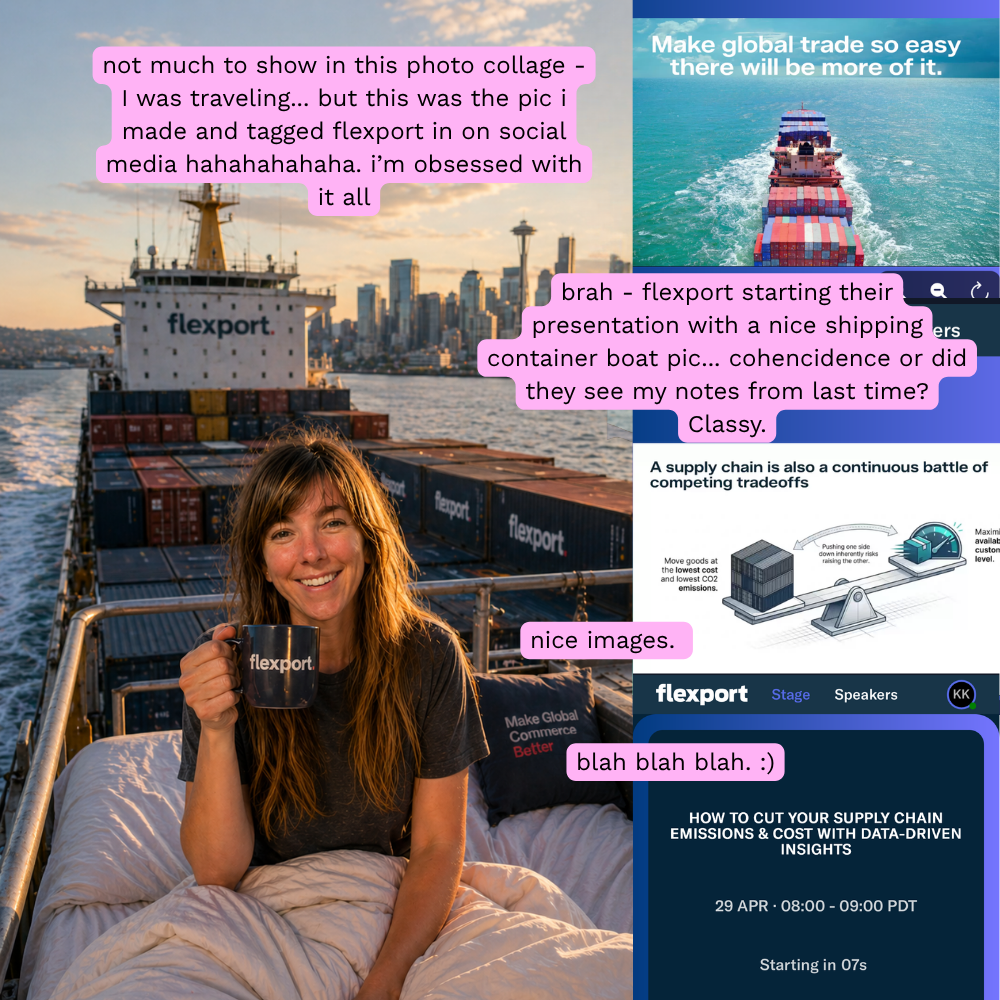
Notes from the Event:
Alright - as said, I was listening on my headphones with my phone and typing on my laptop - all of this while on the lite rail, heading downtown to the next event - the Northwest Events Show. LOL this is so ‘logistical’ of me, writing a blog about global logistics while traveling by rail!! 100 points for Kelly!! :)
Flexport Export team can help you
They want to make global shipping so easy that there is more of it.
love this
This speaker is so warm and has a nice voice haha.
Omg you can’t watch it on your phone sideways! You have to watch it in portrait mode or it disappears. So I can’t put my phone on my laptop and watch it while I type - so… I’l just have to ONLY listen.
Okay so now they’re explaining the concept of “supply chain” with three ‘nodes’ - I keep hearing the word ‘node’ lately. Don’t know what it means still. “A node is a fundamental connection point, redistribution point, or communication endpoint in a system, varying by context.” - idk. Still a bit confusing.
Manufacture (what to ship)
Transport (trucking, sea, rail)
Storage (manufacturing facility? facility?)
How do Co2 Emissions play a role?
Most of the time when we’re looking at optimization, how do we reduce/minimize cost? But c02 plays a role. Every step has a specific carbon burden or impact.
When you look at freight transportation, that can contribute up to 11% of greenhouse gasses.
Mostly today we’ll look at the transportation part of this three nodes.
At the end of the day, everything is a battle of trade offs.
My reception isn’t that great here cause I’m literally logged in from the literail. But it’s not too bad. I’m turning it onto lite mode.
How have emissions been impacted based on decisions of how clients choose to move their woods.
Oh now the other girls face popped up - w couldn’t see her for a long time even though she was talking a lot.
Modality switch is an amazing example of savings. Switching from ocean to air is a 60 times reduction (or opposite if ooo go the other way) - WOW air uses a lot of pollution?! And there are so many ‘for fun’ and ‘for work’ flights a day wtf???
Making sure you have an efficient LCL and FCL priority mix.
Buyers councils are largely a cost labor. How are ew optimizing the supply chains?
Look at shipment level. Consolidation opportunities.
In-app analysis, if you’re a flexport client, holds us accountable to see if we’re capturing opoprtuntie fro you
Bro “Lite Mode” totally works. I tried it for fun last time I joined one of their seminars and now i legit need to use it. There are no breaks in this audio. I’m impressed. Flexy - ya’ doing it.
The historical analysis is half hte battle, the second is the forward looking tool. Look at past opportunities and figure out how to execute on this
There is no off to the right in the grass. I’m like - is that snow? NO way. It has been warm so long… what is that in the grass?
The are the areas we look at at flexport when assessing how clients can save emissions within their supply chain.
How can a client, we’ve got a lot of supply chain managers on this call. How can they look at their supply chain and know if these solutions are ones they can take advantage of?
I can see cars are pulled over by the police on the street below me. A black car.
How do you move your goods the best way? The answer lies in two places: where you’ve been and where you’re going. Maybe you’re a startup just growing and using air freight and need to as quickly as possible to capture market share during the ramp up period. Ormaybe you scaled and speed at all costs isn’t sustainable anymore.
So you look at like how can we shift manufacturing to another
Btw she dint say like, I did. I realize she doesn’t say “like” and she’s so professional/confident!!
How do you look at the past and the future and merge them together. Start with a historical analysis. What has happened in the past. How do we tackle this?
Helpign with strategy
A bespoke analysis is a deep dive of your data. Focus on so many different things.
As we get into the nitty gritty details - which is, as tehy say, where the devil lives, what shoudl clients consider when evaluating what works for them.
Lol I never heard that t, that the devil lives in the nitty gritty details .lol.
So why are your primary goals, constraints, and optimization goals (speed, cost, carbon?) you can’t hit a target unless you set it. Then map out those constraints. Specific container sizing, shipment sizes, stackabiltiy constraints. Lead time for transit.
Sometimes there is a fee every day you’re late.
What levers can we use based on your data. PO size. Are you cutting orders in a way that cut shipping or consolidation opportunities.
Not just buyers consolidation. A bunch of buyers from the same company/client - can all share a container. LCL or FCL consolidation, maybe a supplier at a specific location. Consolidate them into a bigger container than two separate containers.
Also figuring out where this stuff is actually going. Are you using rail, trucks. How are you getting stuff across the country. Pick one method and compile it.
One thing you may notice on this slide? CO2 is not objectively mentioned
Oh yeH! I notice they started their slideshow with a nice picture. Shoutout to last time I attended their event they had a nice picture. A date time before I think NONE!!
Okay now are some examples and case studies. Let’s say you’re coming in from Shanghai doing premium LCL shipping to LA. Several destinations. In the USA maybe Salt Lake City, Dallas, and Ohio… and you’re coming into the LA and trucking everything across the country . Probably for transit time. As quick as possible but not air.
Then you can take a look at your supply chain and see if there’ another way to move your shipment to the location.
You’ll notice that the distribution of whats FLC vs BC, you may see that LCL volume can be consolidated. The cost savings aren’t just “hey how can I ship this” but also “what mode of transportation can I move?
Let’s say you wanna try rail. Can you get to the final destination more direct? Get a hub and go to final destination there. Impact it transit time.
Maybe instead ofd of getting there in 5 days, you can get there in 10 day but also reduce the C02 emissions and the cost.
Uh oh, my phone cut out of video, but it’s back. Boom. Nailing it Flexport.
A girl is sitting next to me who is a bit fashionable and she’s looking at vogue fashion on her phone. IDK the last time I spent time looking at fashion. I feel like all I do is learn. Like I haven’t spent time watching tv or looking at fashion or stuff liek that in forever. Unless it shows up at my twitter. But lol.
New tech is coming out that allows Lower emissions to be more accessible. Battery electric vehicles and such don’t need to be such an expensive option anyrmoe. Maybe you’re moving a warehouse or debating which ports to go into. Start adding them into your framework. Are there opportunities to support this transition?
On that, we’re looking at technology and modality switches. If a client can’t do that, supply chain is very complex and complicated. You can’t move your entire air supply chain to ocean. So are there ways to identify low-hanging fruit?
We have the concept of SKU - one of the biggest cost savers is going from air to ocean. That is a low-hanging fruit and an area we would take a look at. It is a bit of an interesting task to go about doing this.
WE HAVE STRATEGY AND EXECUTION.. WHEN YOU START LOOKIGN AT TYOUR OWN BUSINESS AND SAY, HE, HOW MANY SKUS DO I HAVE. WHAT ARE SKUS?
IF YOU HAVE A STABLE DEMAND, TYPICALL YTHOSE ARE ALREADY MOVING AS OCEAN. IFNOT, CONSIDER TO MOVE IT AS OCEAN. YOU KNOW OVER THE COURSE OF THE YEAR YOU’LL HAVE THESE AND CNA PLAN FAR IN ADVANCED. WITHOUT FURTHER ANALYSIS.
WE’VE ALSO SEEN WHERE WE’VE HAD STABLE DEMAND BUT DO THIS PSAK ORDER. ORDER EVERYTHIGN ALL AT ONCE AND THEN IT STAYS I HEWARHOUSE FOR SOME TIME. THEN DRAW DOWN THE INVENTORY. SOMETIMES WE SEE PEOPEL USE AIR FORHTAT. BUT LOOK AT TYOUR INVENTORY TURNOVER RATES . DO YOU NEED AIR JUST TO HAE IT DRAW DOWN OVER A FEW MONTHS.
A HANDSOME MAN JUST GOT ON THE TRAIN. I FEEL LIEK THIS CITY DOENS’T HAVE TOO MANY HANDSOME MEN SO IT STANDS OU THAHAH.
YOU WEREN’T EPCTING IT ,THAT’S A CANDIDATE FOR AIR. YOU CAWANT TO CAPTURE MARKET SHARE WHEN PEOPLE REALLY WANT IT.
IF MANUCATCTURING AND NEED SOMETHIGN AS QUICKLY AS POSSIBLE, THTAAS AN AIR CANDIDATE.
WOW, AMKES ME THINK LIKE WHAT IF ANTOHER PRODUCT OR I MEAN like travel way gets invested. OMG how long have I been typing in all caps hahahah. For a while. I’ll leave either- but I didnt notice it.
Really it just depends on how definite your forecast is and how much you can plan it in advance to switch from air to ocean.
New products are interesting. It depends on how new: new to the market, no one ever saw it before.
- That might not be a good candidate for the ocean since you don’t know what the edema is going to be.
BTW I’m surprised but my travel time is flying by. So I will be logging out in like 10 minutes or less. This isn’t even halfway through. But then I’ve got to get walking.
- segment your SKUs into different sections (what are SKUs): A Stock Keeping Unit (SKU, pronounced "skew") is a unique, alphanumeric code assigned to products to track inventory internally. Unlike universal barcodes, SKUs are customized by businesses to identify specific product details like size, color, and style, enabling efficient inventory management, sales tracking, and faster order fulfillment; put the “A” products into the ocean, “c” don’t want to look at at all, don’t know the demand reliably.
Once you’ve done segmentation analysis, then you can look at air vs ocean logic and how we choose. That decision is a culmination of a lot of factors. Not just transportation.
So if your transit time changes from 10 to 30 days, how do you handle the fact it’ll be more transit time and you’ll need to hold more inventory. So think about transportation cost and inventory cost.
Yeah I’m one station away.
This is really interesting though. So much to think about!!! Logistics are so fascinating and so many pieces to fit together and so many choices to make, and so much to know and consider.
Identify which SKUs are candidates for analysis. Then, map out your supply chain to figure out the lead times and figure out how far in advance you need to order. This will tell you lead time for air or ocean. This will model out the transit times.
For some reason, I thought Flexport only did ocean travel. How crazy am I. Do they do air and rail and trucks too? I’d assume duh/yes, now that I think about it. LOLLL. omg.
Okay I’m gonna keep LISTENING to this speech but I need to close my laptop and get ready to walk to this conference I’m heading to. OMG but I think I’m running early to this. Event hahaha. Thanks flexport for giving me motivation to get up early.
When I arrived at the venue for my next event, I got a seat to finish taking notes of the flexport talk but it suddenly cut out. IDK fi that was me or them . But they were having interesting talks while I was traveling here talking about what is an acceptable amount for a shipping container. 70% is acceptable in different circumstances, for example. Stuff like that.
Also, on my escalator ride up to the 3rd floor, there was a guy wearing THE MOST cologne. Oof.
Now I think I’m early to his event, which is surprising since it starts in the morning, but again, Flexport gave me motivation to wake up early and learn. Thanks, Ryan’s team… :)
Let’s see how the rest of the day goes. I think the doors for this event open in 10 minutes. Yes. Ten minutes, people, get ready.
And btw I’m. Super dressed to impress.
Until next time, I wish you the motivation and success to search for opportunities around your area. Search and explore: Who is out there giving talks? There are new things happening all of the time.
Find relatable or interesting topics you like and check them out! Maybe even something hosted at a cool venue, if there’s no other reason to go. Let’s see what you can learn and discover not too far from home. 😊
