
A Surprisingly Great Talk on Charming the Public into Framing AI’s Errors
Disclaimer: Everything below is a mix of what I observed and heard during the event. The goal isn’t to pinpoint "who exactly said what," but to share (usually) an outsider's view and overall perspective on these industries. I’m not here to act as a definitive firsthand source—readers should do their own research. I hope this inspires you to attend events, explore new industries, and hear what leaders are presenting. These notes combine my observations with thoughts on how things could run smoother and how ideas connect (IMO). I’m not an expert, you know? Just hanging out in the room with them. EnjoyTopics Include: AI, Technology, Culture, Charisma, Charm, Influence, Public Opinion, Journalism, Truth
Okayyyyy controversial event!! This is one that I’m kinda like, uh… okay… let’s see. Cause we’re gonna go to the local famous university and hear people talk about generative AI… and turning it into a public problem. My guess of the things they’ll state as problems: data center energy uses, hallucinating, lack of “human in the loop”, and loss of jobs.
Why Attend: Anything related to AI lately, I’m pretty much guaranteed in (unless it’s like “what is a prompt” - we’re beyond that). So, I am actually a really optimistic person about AI. I just think it’s enhancing things and giving us information to improve our world (like the openclaw talk i went to a few weeks ago where they said they can use info to improve conditions in dairy farms with 30k+ cows, now they can actually track the cows and improve their lives!!), and helping people achieve more of their goals. It’s just a super useful tool. For me, it’s totally not getting me to “stop thinking” it expands my mind and what I’m accomplishing and how I think. I feel it challenges and meets me at my level, unlike anything else can. I also think there are lots of monopolies in energy, and lots of energy sources have been intentionally bottlenecked because of corporations making money off of not giving the public all that is possible for technology. I’ve just been really interested in ancient technology and like even how Mayan civilizations and older civilizations were built like power boards and microchips and how people believe the pyramids are a power grid and can get energy from inside the earth. Lately, I’m so into that stuff, so I'm just really optimistic about the future and energy (totally believe modern energy is a psychop), as more things start to be disclosed and unlocked. So, that’s me. Hahah. Who knows But, I’m going into this event as a bit of a contrarian. I embrace AI.
Photo Collage and Commentary:
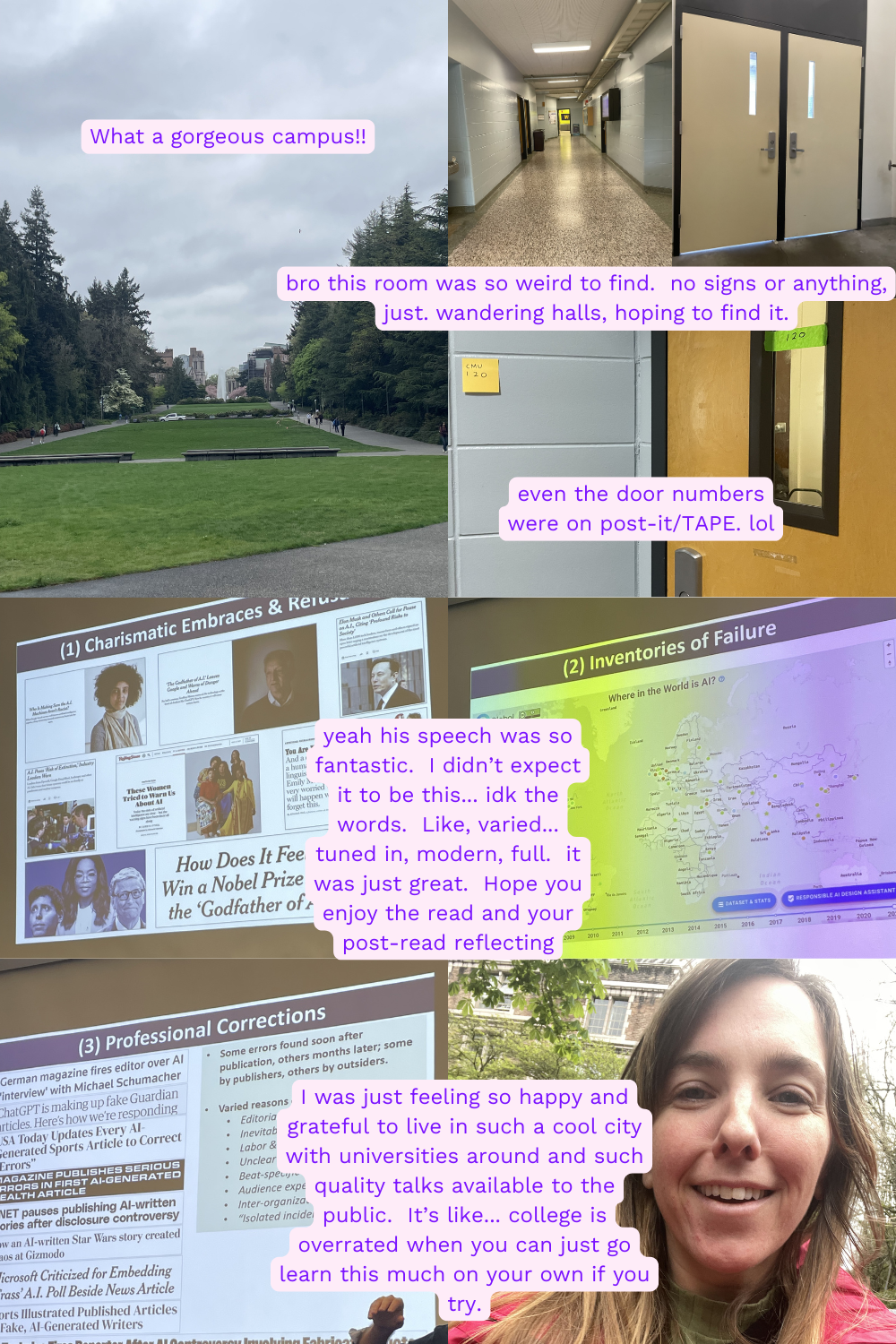
Notes from the Event:
How can this contestation of the word “public” be lite? How can we use it to make sense of this moment?
He asks what the heck is a “public problem”? He’s a bit of a pragmatist, materialist - publics are thing made through sharing consequences, communication, relations to each other - doesn’t matter if you’re interested in it, it’s interested in you Different than community, interest, or group. A notion of shared consequences.
Some people think It needs to be regulated, some think it’s a bueocratic tool to use to solve problems. Some think its an object of concern or deployment for public facing instutitueions (journalism, civic media), whats a public sphere and structure - what does it mean to bring truth when the truth is wrong/hallucinating 8% of the time
People keep grasping for a difference and it may or may not be.
Today, by the lack of comfort with “AI” and “publics” and trying to determine what is/isn’t a public problem, let’s talk about three places where AI is being made into a public problem. Public problems, tehy’re never found naturally in the wild. LIek how you don’t find news in teh wild. Journalism doesn’t exist int eh wild, it’s made by people, practices.
You don’t find news in the wild and you don’t find problems in teh wild. They have to be made.
So how do these problem get made. That’s the guiding question for these scenes
A discursive (made through discourse)
Made by accountability frames
Its a professional challenge
He jsut wants to say he’s going to use some words liek “error” problem and "publics“ - he really takes a sociotechnical perspective on what is ai. A collision of people, norma… he wants to hold onto the term of AI loosely and not have it be collapsed or bought down to a certain thing. He’s inspired by a lot of work, thinking about errors, failures, breakdowns. A lovely body of literature USD on the broken world shining. Where errors come from. How are they made to be errors. Who suffers unevenly, and how the encounters can be little sociodiagnostics. Ways of seeing how power circulates.
Permanently beta - the idea that errors are a way to see how risk has been distributed in society.
If you didn’t care if it fails or not, it’s a certain privilege that insulates you from the risk. If you’re close to the chance of a failure or breakdown, you’re skating close to the edge and may not have a lot of social or political reserves to insulate yourself from failure.
Errors show us into ways of power.
Think of publics as material communicative constructs
Hahaha this guy has a huge vocabulary hahah. i can’t even spell 10% of hte words he says and hardly know their meaning.
The specific claim to make today: generative AI becomes a public problem when accounts of its “failures” articulate ideals of “public”
The idea that “failures” will be that world (errors/failures/brekdowns)
And then these ideals of public - what we think public should mean, waht we want it to mean, and what w work toward it meaning
Scenes of failure mean you see types of public
I’m like omg this guy is giving the most intelligent/interesting speech I’ve heard in so long hahahah I’m loving it but I’m still confident
Think of failures and publics in correlation and orin concert with each other
The first scene of public and problems in relation to generative AI: charasmatic embraces and refusals - a long history of charisma, hype and how particular individuals in society have the ability not embody normative perspectives, call things out as problematic and celebrate some things
He has a book on screen called “The Life, Death, and Legacy of One Laptop per Child, “The Charisma Machine “ - omg!!
How magnetic personalities shape global politics
Lots of things reward the charming people. The not-so-charming people get to be left out of the conversation, same as ideologies.
Charming people are in this conversation. Is it an existential threat and the downfall of society or is it going to save us all.
You see the individualization of if AI is a problem or a solution. Theys grappling of AI as a problem is impossible to do without the charming individuals who have these beliefs.
He doesn’t have any beef with these individuals as people, but they’re charming, charismatic people who are circulating within and helping to make AI a problem or not
DANG this talk is so cool!!!
How do they do this?
1. Charismatic embraces and refusals: a bunch of open letters. Many of you are asked to sign them or the counter-opening letter. Letters asking to pause AI completely, letters saying AI should be erected, too dangerous. An experiment to be continued. The act of adding your name to letters. It’s emboying if AI is a problem or not.
The people are with us, these charming people, with us physically y’all the time. These are people having different disagreements.
It at least passes a smell test
I still don’t know what is a “smell test”, flexport talked about this too
I looked it up: Vaguely, a "smell test" (or "sniff test") is an informal, intuitive assessment used to quickly determine if something is genuine, ethical, or reasonable. It is a metaphorical check that relies on gut feeling—rather than rigorous, formal analysis—to detect if a situation or proposal is "spoiled," dishonest, or fundamentally flawed. Dictionary.com +3
My smell test? “How do they feel about GameStop/Ryan Cohen?”
The first thing we’re having here, I can talk about more data nd what we’re basing this on ,but we’ve got these competing problem frames. An extesential risk. A problem of concentrated power. Opaque systems, structural inequalities, iteration, education and timelines
Some call for collective action like pausing, building literacy, transparency, system audits, waiting a bit longer for the timeline, devolve the power to build
Personalized legitimacies: technical expertise, industry histories, community standing, social media following, marketing and celebrity
The guy sitting in front of me, in the front row, is codeing right now hahaha. And then the other lady to my left has a notebook out and so far she’s written one line down in notes - just says “the texan library”. Lol
Types of personalities and charismatic individuals are among us. So, waht type of public is this - the public here is a mass to be activated. Emobodied agonistic, affective strategic charaismatic individuals who are almost acting as fiduciaries for us. Taking care of us, embodying our outrage. You may agree with some, disagree, identify with some. A. Charismatic embodiment with teh problematic problem of AI. We get to watch it, observe it, called to participate. We are a public read yo be activated and called into service by charisma
Oh the last in front of me writes one more line - hahaha idk waht she wrote, but that triggered something
There’s a cottage industry here, inventories, dashboards - moments AI has failed and broken down and made a mistake of sometime. Caused an error
. What does “cottage industry” mean? “A cottage industry is a small-scale, decentralized manufacturing business, often operated out of a home by individuals or families rather than in factories.”
He said he can never do this acronym: AIAAIC: the AI Algorithmic and automation incidents and controversies database
A charismatic person who’ll take this over
Partnership in Incident Database - evidence of judgment on what counts for this
They focus on errors of AI around the world through mapping. The OECD has another inventory of errors and failures and breakdowns of ai and they match it with news stories.
Their interest is mapping geography of failure to a more in-depth description/discussion
There are snapshots you can take and send it to him. The moment they fail. Its intimacy of it. Talking to a chatbot and it really messes up in some way. A more casual way. A more intimate way to
He gets a spam call while giving the presentation hahah
What’s going on here? This set of imperial examples here? How are these building up to particular publics? Evidence of how publics make themselves?
- These types of erroneous accounts with AI, they foreground incidents. They want to codify and quantify harms. Based in events. A. Flashpoint events. Not long-term structural events. Usually, something happened in a moment. Different accounts and representations drove these inventories of error. A way of thinking about this as a thing meant to be analytically distanced and talked about.
Dude I’m tired!!
Your’e asked to submit your own events where AI has messed d up in some way.
So, what kind of public is this? There’s a different type of self-public at work here than there was with the charismatic or charmed individuals. The public here are the people impacted, outraged by these events. This is an event-based account of what error/failure means. This ia bout trying to make sense of events. We, as the public, are asked to understand, engage, and contribute to them. Find our own analysis of what they are. Meaning-making. Not better or worse, but we’ve already got two ways of thinking about how AI is problematic. Made to be a problem.
Last one - Professional corrections - professional practice
Journalistic practice. Many of you know way better than I do, this is paorfession that thrives on being truthful. If you as a student make a factual error in a news story, you’re supposed to immediately get a zero. Zero tolerance policy for error. A profession that prides intel for getting 100% right. Retractions, corrections, lawsuits. It doesn’t play fast and loose with the truth.
But with AI lots of mistakes are being made.
One magazine made up an interview about a guy who doesn’t do interviews. One company was making sports articles has to go back and update all their articles cause they all had errors.
Let’s not demonize journalist. They have structural conditions wihtout a lot of pay and it’s not surprising error develops out of those conditions. We’re building to a different kind of public. Some journalism errors come from places that are baked into journalism as a profession. OSmeitmes it corner cutting, sometimes its experimentation.
Btw this room is so small of this talk. Jsut like 50 chairs in total and each one is taken except the font row and then peopel standing at the back of the room.
What’s going on here in terms of the public? The public here, is an audience (I’m open to other interpretations) is an audience for autonomous, truth-telling, self-monitoring, and self-correcting professional journalism.
This publicness lives in teh professions ability to regulate, observe, and reflect itself. To not only do your work but step outside and ask why it happened. Why did something different happen. How coudl it have been otherwise.
A public expecting something of journalism. Not content, but news. Use them differently.
Now a bonus point: this “news language” error has him thinking of other errors - are they errors?
In the aftermath of hurricane Katrina. So the top image is a black boy and its ays he’s looting a grocery store and then it shows a couple that is white on teh bottom and its ays they’re finding bread - so basically its racist.
Not rocket since to sy there’s an absolute race dynamic going on here. People of color loot. White people find. Not trying to overgeneralize - but it’s within a reasonable caption. This is the type of caption that slides by a lot in journalism. We can juxtapose them together and see what’s going on here. This is the type of use of language - not making up an interview. Something else going on here.
Whats that “something else”?
This reminds me of when AI can get really “stepped away from your problems and tell you to go talk to a therapist and stuff and acts liek its patronizing, dependin on how you stat the conversation. So much depends on your intial framing and it can be super helpful or super judgemental. All depends on how you start the conversation and frame it.
“Wife” of LA Clippers owner (doesn’t give their name)
“Some stumbles.” “I think that, uh, this is such a, a-you know, I think that, - this is a, um this is of course, a, um, very longstanding, um policy” -
Usually journalists dont’ quote speech like this.
There’s something going on here If you had the tape, she did speak like this.
Trump “expressed condolences” - “sadly there will likely be more before it ends, that the way it is, likely will be more.”
“The first three American deaths in the war” - why “the first” - pointing to more to come.
USAID is keeping just 290 of 10,000 (Just “ is making judgment.
SO there are ways to think about this - “stance words” specifically look at how stance words relate to journalism. Stance words are how journalists regularly sneak in interpretation and judgment into this profession which is supposedly just facts. Factually based truth-telling profession. But no, look at adverps. Things down obviously, clearly, apparently, presumably - these are the types of words probably not going to cause a problem for a fact checker. But it’s a type of journalistic, editorial power. Storytellign aspects too journalism
If journalism uses mature subjectivity to be a “stance profession’ then what publics care of r’stance errors’?
Are those errors?
Will it get better? Error rates will go down - fast forward 3 years from now, tehy’ll get better with fewer errors. It’s not a good idea to focus inquiry on those types of errors. They might go away.
LOL now the guy in front of me is researching the speaker seeing what he’s done about errors and what he’s written about it - asking AI about it - has he ever cited work etc. OMG he’s asking if this guy has ever cited the work he wrote to AI - so is the guy in front of me an author and now he’s researching if this speaker has ever cited his work!!! Holy crap that’s so cool.
This guy in front of me (the one who was coding) is talking with AI, asking if this speaker has ever cited his work. HIS work. But he’s also programming during this talk. Wow. lol. You never know who is in the crowd, huh. May be a fellow researcher, may be kelly tutors.
Journalism is meant to have a stance grounded in something. Good argumentation. Are they stance errors/. Errors to e engaged with in a different kind of way from a factual error?
I’ll stop soon to wrap up. This is the space of interpretation. Way soft thinking about what language and communication are doing in relation o generative AI. Checking an error wait
LOL now he’s like - I can’t find any citations in his work related to his blogs or papers - and the AI is like, yeah, now that I looked - there is overlap but not formal citations. WOWWWW. Amazing.
Algorithmic media needs (idk) wow.
Moments of interpretive flexibility with competing interest groups to describe the significance of tech. Various eventual closure.
- The curious connection between apps for gay men and sex offenders (that’s what he’s looking up + beef panties?? Beef panties????????? That sounds like pizzagate or something. I’ll be honest.
this is out of NOWHERE. he was coding, he’s a researcher, and then what? is he trying to take down sex offenders?
Coming from many different types of forces, it’s a way to keep this thing alive and trying to say “just use it wherever you are” - keep an eye out for error
To end, come back to the fact that we’ve got accounts of failures, which show us ideas of the public, which show us failures
Cottage industry of people who put adjectives in front of the public. If you want to get a paper published, put a word in front of “public”: ifnfastucutre public, recursive publics, also publics, participatory publics, textual publics.
Okay I’ll leave early before the Q&A cause I need to get my daughter soon.
This event exceeded expectations A LOT.
Until next time, I wish you the motivation and success to search for opportunities around your area. Search and explore: Who is out there giving talks? There are new things happening all of the time.
Find relatable or interesting topics you like and check them out! Maybe even something hosted at a cool venue, if there’s no other reason to go. Let’s see what you can learn and discover not too far from home. 😊
