
Quantum Computing + Quantum Mechanics Almost Outpace my Patience
Disclaimer:
Everything below is a mix of what I observed and heard during the event. The goal isn’t to pinpoint "who exactly said what," but to share (usually) an outsider's view and overall perspective on these industries. I’m not here to act as a definitive firsthand source—readers should do their own research. I hope this inspires you to attend events, explore new industries, and hear what leaders are presenting. These notes combine my observations with thoughts on how things could run smoother and how ideas connect (IMO). I’m not an expert, you know? Just hanging out in the room with them. Enjoy!
Topics: Quantum Computing, Prehistoric Tech (?),
One of my biggest goals lately: learn more about quantum computing. What I understand about quantum is that many things can exist at once. Many options, many realities, many timelines. Even that quantum super computers can go into alternate timelines and fine answers to questions and then bring them back to the present. I believe that quantum is a HUGE deal that we hardly understand, at least the mainstream majority. So I’ve been going out of my way nonstop to learn as much as I can about it lately. So far, its not too much I’ve been able to find, but this event just popped up, ONE DAY AWAY so I’m heading over to learn and take notes. Quantum is the future!
Why Attend: I am just completely fascinated with physics and what’s possible. I have a very open mind towards what is really going on, on planet Earth and think a lot is related in the send of quantum, spiritual sense, information/science, and our history. Some of my favorite podcasts lately look into quantum and question our education system A LOT - and I believe a lot more disclosure and whistleblowing will come out about all that is possible for humanity, and what has been hidden in our history. My favorite podcasters lately are Alienated, Elizabeth April, and The Maverick Approach (though sometimes TMA can be a bit cocky/too cool for schooL) though they bring on good guests and are well tuned into things.
Photo Collage and Commentary:
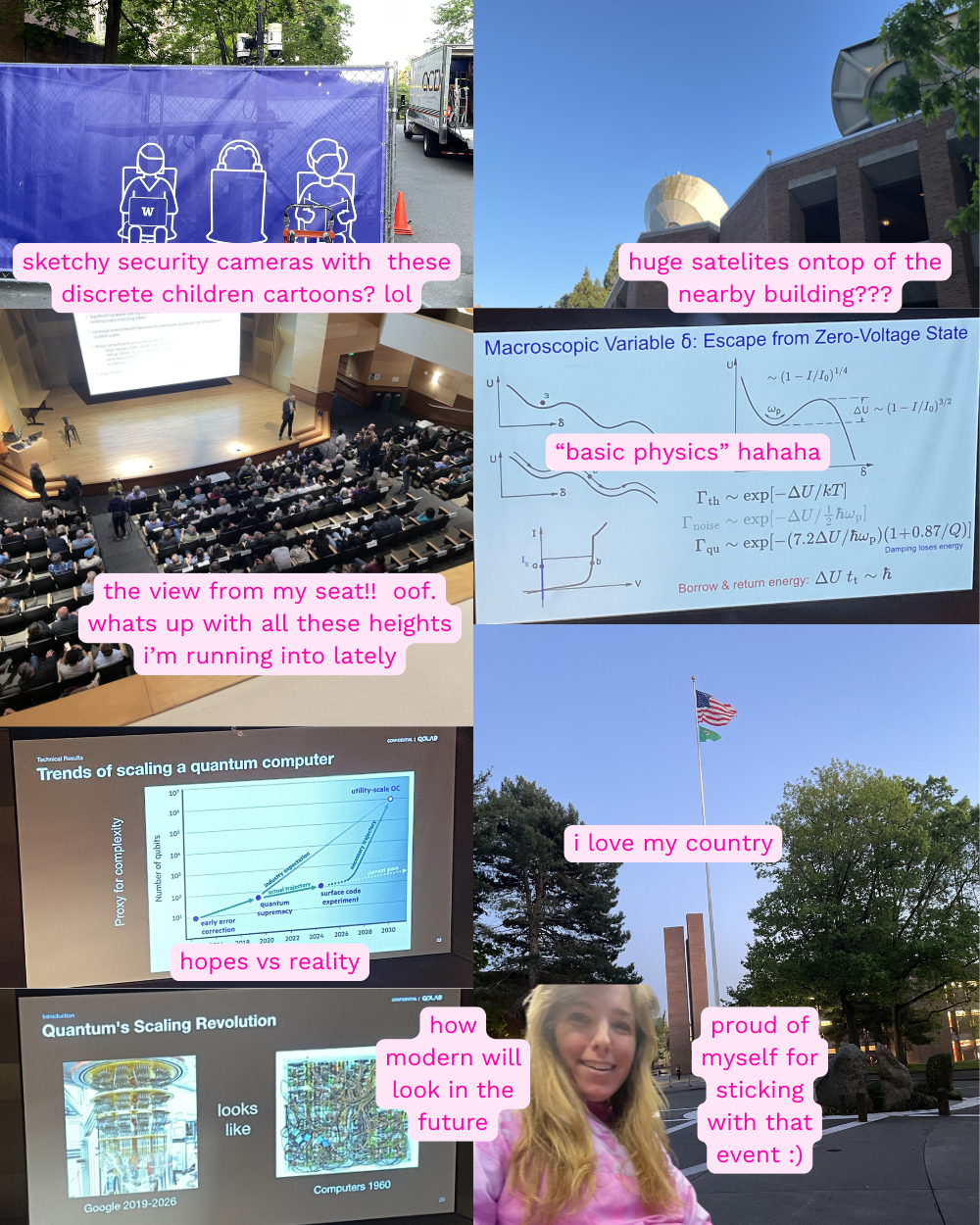
Notes from the Event:
Do macroscopic variables obey quantum mechanics?
This place is super crowded. Hundreds of people here and I had to go sit on the balcony and it’s like 1,000 stairs to walk up. But I got front row on the balcony.
You can see quantum mechanics on a macroscopic scale.
Omg their fold-up tables here are so awkward and I just made so much noise trying to set it up. Also, I am sooo thirsty. I forgot my water bottle for the first time in like a year or more. Okay, let’s get into it. Honestly, this guy is not easy to take notes from so far. Probably cause he’s using so many scientific terms.
Okay:
So if you set up an experiment right,
-if you talk about a macroscopic variable, take a lump of matter and heat it up enough, it turns into a gas, it’s very complicated you have to know what the atoms are doing. It’s complicated to know exactly whats going on. Then if you cool it down, to become a solid, then the atoms are settled down. If you talk about a part of it, thats a macroscopic variable. The same thing happens with (idk)
The electrons are basically flying around, doing their own complicated thing. When you cool it into a superconductor, the electrons pair up. They pair up with one going in the exact opposite direction with all the electrons. This is a lot of freedom. In fact, phase state has a chance and that corresponds to the current flowing from the super conductor.
Idk why I thought I’d understand a lot of this talk but so far I”m like omg. What???
So because all of these electron pairs have the same phase, it adds to a large current liek in an MRI magnet.
You can’t put an infinite amount of current through the wire, then it breaks the superconductivity. Now I wanna go relook up what he’s talking bout and the description for this event. Cause I’m like uhhh this is like 0.01% making sense to me and idk if I wanna stay here. I hope it gets more simple. Lemme go check the description of this event. Cause now he’s talking about looking at the physics of I=I0sin(and then these symbols ive’ never seen. OMG omg omg now this is wild. Generic physics. I hope al to of you have sen this already. Basic physics
Basic physics?? BRO this is like hierophanies.
Nature as a banker can give you delta U to go over the well, but it can only give it to you for a short time. T. Like a nervous banker recalling the loan time.
- Okay apparently this guy won a Nobel prize in physics. Recently. So, I’ll stay. But… I don’t get it all.
You can have energy loss, discepation int he system. You want to know what the effect of discopation is? It turns out if 1/q= dissipation and qu= oscillations, before you lose energy.
You can understand this with a banker analogy in the sense that because it’s losing energy, if it wants to go from here to here.
So now, again, I want to talk about the experiment; this is again for the students here. We got outside, we’re going to do the experiment. We hooked it up in some simple ways, one kelvin, its very easy - and the results were a complete disaster. DIdn’t work at all, didnt make any sense. DIdn’t understand whats going on. Then we had to retrench and get it to work properly and understand it.
Initially, you may not have all the ideas right. There were two main ideas to think about. One is that this is a very sensitive device and we have to filter out all of the noise coming from room temperature. We filtered that with a copper powder filter. Very strongly dissipates at all frequencies. We talked about this yeteray, we reminded everyone bout it.
Then the other thing is you had to do microwave engineering. You have a chip about a centimeter across. Then it looks into a collapsed cable of your line, like you’d see in older TVs and that is a well designed microwave.
Lol I’m feeling like a fool for thinking I’d easily understand this QUANTUM PHYSICS, just walking in like hahah like idk. Overconfident.
We had to work hard to figure out the physics.
Then this is the next thing for the students. When we thought about this, previous experiments were kinda murky. In the sense they measured some effect and some small temperature to change.
What we did is we decided we have to measure all the peramiters carefully to compare the experiment results with a theory.
BRO I wanted to learn about quantum stuff. But I think he’s just talking about an experiment he did and the results. Ugh. I want an ice cream sandwich or somthing hahaha. My local grocery store is selling them in singles for 97 cents and now that’s what I’m craving hahaha. The opposite of this.
Oscillation frequency, sampling Q and cubic potenital and arrhenius-type plot
Okay here's your cheat sheet for those terms:
Oscillation frequency — how fast the particle bounces back and forth in the energy well. Like a pendulum. Higher frequency = more quantum-y behavior possible.
Sampling Q — measuring that quality factor we just talked about. How long does the quantum state last before it decays? They're measuring it experimentally.
Cubic potential — the shape of the energy well isn't a perfect bowl, it's lopsided like a cubic curve. This matters because the lopsided shape is what creates the "cliff" the particle can tunnel through. It's the specific geometry that makes Josephson junctions work as qubits.
Arrhenius-type plot — this is a classic chemistry/physics tool. You plot behavior against temperature on a log scale. The KEY thing he's showing: at high temperatures, the system behaves classically (thermal activation — the banker giving energy the normal way). At low temperatures, the curve stops following the classical prediction and goes flat. That flat part = quantum tunneling taking over. That flat line on that graph is literally the proof that macroscopic quantum mechanics is real.
Btw I’m doing research on the side to figure out what he proved. I”m confused.
Claude says: Okay from scratch.
Classical world (what we're used to):
A ball is either here or there
A door is either open or closed
You either have energy or you don't
Things behave predictably
Quantum world:
A particle can be in two places at once — until you look at it. Looking at it forces it to pick one.
A particle can pass through a wall it doesn't have enough energy to climb over (tunneling)
Energy comes in discrete chunks (steps) not a smooth ramp
That's it. Those are the weird rules that govern tiny things like electrons.
The crazy part:
If you throw a ball at a wall, it bounces back. 100% of the time. Classical.
If you fire an electron at a barrier, sometimes it just... appears on the other side. No explanation in classical physics. It tunneled through.
What Martinis proved:
That tunneling — that impossible-seeming wall-passing — doesn't just happen to electrons. It happened in his chip. A human-made object you could hold. The current in his circuit tunneled through an energy barrier just like an electron would.
Quantum mechanics isn't just a theory about the subatomic world.
ME: so he proved multiple timelines exist or whatever - and like "seeing" locks things in?
Claude responded: Ha — you went straight to the deep end.
Ha — you went straight to the deep end.
The "seeing locks it in" part — yes, kind of.
That's called the measurement problem. A quantum particle exists in superposition — multiple possible states at once — until something interacts with it and forces it to "choose." That interaction is what physicists call measurement. It doesn't have to be a human eye. Any interaction with the environment can do it.
So yes — observation collapses the possibilities into one reality.
The multiple timelines part — that's contested.
That's the Many Worlds interpretation of quantum mechanics. One legitimate reading of the math says: when a particle "chooses," it doesn't actually collapse. Instead the universe splits and both outcomes happen in different branches. You just end up in one of them.
That's a real theory that serious physicists believe. But it's an interpretation — the math is the same either way, we just can't agree on what it means.
What Martinis actually proved:
Not timelines specifically. He proved the superposition and tunneling are real at macroscopic scale. The philosophical implications of what that means — timelines, observation, consciousness — that's still an open fight in physics.
But here's the pattern recognition angle:
The fact that reality is genuinely probabilistic until forced to resolve — that should sound familiar to anyone who studies systems, markets, institutions. Things exist in superposition until something forces a decision.
You've been thinking in quantum-adjacent frameworks longer than you realized.
ME :huh?? dumb this donw for a 5yo
Claude responded: Okay.
Okay.
You know how in a fairy tale, Sleeping Beauty is asleep and she could wake up happy OR sad?
While she's asleep she's kind of... both. You don't know which one is real yet.
The second someone kisses her and wakes her up — she picks one. Happy or sad. Now it's locked in.
That's quantum superposition.
The particle is Sleeping Beauty. Asleep = both possibilities at once. The kiss = someone looking at it / measuring it. Waking up = it picks one.
Tunneling is even simpler:
You're playing outside and there's a fence. You don't have enough energy to climb it. So you just... appear on the other side anyway.
That's it. That's tunneling. Quantum particles do that. They just show up on the other side of walls they shouldn't be able to cross.
What Martinis proved:
That a big chip — not a tiny invisible particle, but something you could hold — does BOTH of those things.
Big stuff can be Sleeping Beauty, too.
Okay, Claude and I got into a big back and forth, and I’m still a bit confused. But let’s get back to this guy talking:
He’s talking about the next experiment. It’s about energy levels. Let’s talk about an analogy and an experiment form 1998. When you look at an incandescent lightbulb, it gets hot, and it radiates light of all different frequencies. However, if you put neon gas and run current through it, you get distinct and vivid colors. Why is that doing that with neon gas? Because neon is an atom, a quantum particle.
What I believe is that text books shoudl be showing another experiment where you can directly see quantum mechanical behavior. Only cause of new quantum devices peopel have been building that its so simple. A very simple experiment. Take a laser at room temperature. Pulse it for a few nanoseconds, bring energy from a fiberoptic light. Tenelators and shine it onto a microcalorimeter and then it absorbs the light, energy converts into heat, heats up, then decays back down to the whatever base temperature. The heat it rises to is proportionate to the energy absorbed.
When you do this, you expect the temperature to go up, go down.
But in the quantum regime, you see this going up and down, but theres now bands of where the temperature goes up.
If you histogram the peak height, you see the ground noise, the peak, then the second peak, the third, fifth. Insteaedod hits bingo one line, its a series of lines separated by (idk)
- when you measure the energy of a light pulse, its surprising light behaves this way. Surprising for quantum mechanics. It’s really direct and you see it on the oscilloscope. The strange nature of quantum light. Energy comes in quantum values. This is what we were seeing.
Bro. This is 100% more complicated that I ever expected. Haha the last talk I went to about quantum as hardly easier to keep up with. I kinda think I’ll leave and go to my guitar jam - and, keep my eyes out for more quantum stuff. But idk if I’m getting anything out of this.
I’ll stay 5 more min and if I can’t keep up at all, I”ll head out.
Your basic building blocks are the periodic table. We can build quantum mechanics with new building blocks. Microwave photonics, nano magnets, the playground for a physicist to explore quantum mechanics, has increased over time and we like having a new playground to play in.
Next I’m going to talk about what happened after this. It’s a bit technical but interesting. Tunneling Traversal Time.
I went to France and wanted to directly measure the time it takes to go from here to here. How long is the banker loaning us the money/energy?
A circuit board where we have copper here and here, some grounds, a center line, and we functioned and had the load which capaciculated and shorts
Yeah. No idea. Oof. Woah. Hahahahah okay. I’m out. Oof. My mind is worn out from this. So unexpected 1000)% complicated. Can’t even fake it.
Woah - wiat - interesting:
In a quantum computer, we have all the operations as a classical computer; we have new operations and an expanded instruction set. A weird quantum mechanical state where you can store much more when it’s in a quantum state. You can build new algorithms and do vey powerful processing. Quantum mechanics gives you extra Power
|0> +|1>
Run through the quantum computer, you’re computing what happened with the zero state and what happened to the 1 state when it went through. That’s some kinda parallel processing. You’re doing two possibilities but only doing it once. SO you get kinda parallel processing. Big deal, right? But what’s really interesting is if you start doing this with more and more qbits, then you have four states you parallel process through. 3 = 8, 4=16, 5=32. The amount of parallel processing is growing with the number of qbits exponentially.
50 or so acts as a supercomputer and if you get to 300 its more states than atoms in the universe. A huge amount of to processing.
There is a problem in that although you get this parallelization, you still have to measure it. And you just get 50 or 300 possible bits of information. You can’t look at it, it collapses the information. So you have to build very special algorithms. There are only certain algos that work, Some things you can do that are very powerful.
Algorithms:
Factoring, security of RSA protocol
You can break the internet. Break bitcoin.
Show, first algorithm
Quantum-resistant protocols exist
They’re going to replace all the protocols from RSA (quantum breakable), but it’ll take 5-10 years.
Bitcoin is easier to break into. New papers are a couple years old. If you’re interested in bitcoin security, they’re very interesting. And you’re gonna have to think about it.
I don’t want to break anything, not my life’s ambition. I’m interested in quantum chemistry. It’s hard to simulate atoms and molecules cause they’re quantum. You can map quantum chemistry into a computer
Quantum Chemistry
Natural mapping of qubits to electron bonds
Many technical applications
Known algorithms, useful and powerful
Need error correction, 100k-1m qubits
Ways to solve the supply chain that don’t rely on the Strait of Yarmouth
Building the systems:
physical: superconductors, ions, electrical traps, photons, semiconductors, diamond, wave
Many organizational approaches
Let’s talk about when he was, his whole career he’s been tryin got build up quantum computation. It culminated when he was workign at google. Many very talented people there. The quantum supremacy experiment.
Does macroscopic Q-Computation Obsey Quantum Mechanics - does it work at this scale?
53 qubits debvice have adjustable couplers. Qbits are on teh chip, buckled onto the device and wire around it.
The amount of computation tis 10^16. Woudl we see quantum effects and quantum computation?
Tried some random numbers, some more possible than others. Then we got out of the quantum computer with quantum simulation. And although our quantum computer chip is not perfect, no qubit chip is perfect- it did work for some fraction of the time. We saw there were no additional physical, mechanics, unknown physics. Beyond the 1 or 2 making errors.
Quantum mechanics is operating in teh way we’d expect. SIcne then people have expanded and it’s a good test to see if your quantum computer is working properly.
Basic physics look good. It’s an important part of that.
So 1985 was his experiment. Then google in 2019, lots of great people working on it together. The big tech jump in 34 years. We had a long way to go to build that. SO what are we going to do in the next decade? What is it going to look like?
His vision is what it’ll look like.
When we show this to superconducting cubic field, tehy’re super doubtful this will work. Seems liek a big stretch and its kinda depressing people don’t get it but it reminds him of all the important experiments he’s ever done in his career that people don’t understand, get, see how it’ll work. This is actually a good sign since people are doubtful. But you go to make sure you’r not diluting yourself. That’s important here.
But when I look at what we’re doing right now, it’s nice. We got al long way with it. But it looks like what a classical computer from the 1950s-60s with transistors buried in there, tons of wires - okay, you got computers to work. Useful, butits’s not what you want it to look lik. You want it to look like a microprocessor in the 70s. Mass produce it easily, cheaply, and well.
Then you can do it in the future and build processors.
So where is the filed now? People don’t liek me showing this, but I still liek to show it anywhere. We have the number of qbits - is as we make more qubits, they become better and more complex. We’re making more and we’re making them better.
Moved to Google, with a team, then left.
In 2019, all excited, saying “look, let’s build a big beautiful quantum computer, 1M qubits”. This was a bunch of expectations that it’d go well. What we wanted is not actuality.
This worries him, and he’ll explain why. If you extrapolate this and think about you million qubits. He will certainly be dead by the time it happens, and all of you will be retired at best. That’s not good. That’s not hte pace we need. How are we going to accelerate this and get much better here?
People are working on it, but I want to radically accelerate it. How?
Qubit fabrication with tool-builders such as Applied MaterialsSC needs latest semiconductor fabrication
Build new industrial fabrication tools
Focus on reproducibility, quality, and scale
Improve EVERY process step
Need a custom 300mm deposition tool - one acute system can go between many chambers.
Basically focused on reproducibility, quality, scaling up. Make this in a way that really will work well for building these qubits in a booed way. It’s really exciting to work with these experts.
Now the next part is for experts.
Okay hahaha now I’m like - okay all of that was more what I thought I’d be here for. That was easier to follow - the past 30 minutes or so. This talk has 30 minutes left. But I’m like omgggg hahaha. I wanna go home. No offense. But it’s late, I did over 10 interviews today. All I had to eat was soup. Oh - and I just got some sushi before this. So, not as pathetic as I sound.
Okay. I’ll do my “stay 5 more minutes” and go if needed. Literally, I was packing up earlier when he suddenly started making so much sense, so then I got my laptop back out and was typing hahah. So let’s see how this final chapter goes.
I wish there was networking here!! I bet super fascinating peopel are hereeee. But I think it’s more like “movie theater”/“live theater” styled and no networking after. Not even snacks. Eyerollll. Not even chocolate chip cookies hahaha omg I’m so craving a sweet, huH????
Build qubits 14 cm by 14 cm, then take a silicon wafer and collect it from 20 M Kelvin to 3 Kelvin with 1000,000 wires. If you know about silicon, you’re going to say it has the thermal conductivity of copper, you’re right - this won’t work? You’re wrong, there is a way to do this.
OMG. I may go. This is back to technical. I Amy miss a minute or two of insight, but idk. I think this is him trying to teach people how to build more qbits and reach 1M - but… that’s not my world It is but it isn’t. Okay. I’m gonna close my computer and pack up again . If I type any more beyond this, it means I reopened my computer and he was fascinating again hahahaha .
W’re focus on low-end quantum processing units. Working with digital, Synopsys, Nasa, HPE, UWisc, USCB, AMAT, QM, 1QB, universities, California, California, Texas, Israel, Canada, (even an actor with his first name as my last name)
We don’t give all the good stuff cause it’s competitive, but we share.
We’re going to have refrigerators and wiring to electronics to control and do correction. This is what we’re looking at. 100-200,000 per dilution fridge.
Summary:
Significant hardware and manufacturing challenges are minimized or overlooked by existing supercomputer efforts
- people are being optimistic
Leverage semiconductor fabrication to dramatically accelerate the fabrication of scalable qubits
Active consortium to accelerate progress
Large industry
Startup
Including QOLAB - which they want to turn into a new scalable worth without the U
Lots of people laugh
Government
Academia
Cost: scale to the millions of qubits with wafer-scale integration
Thank you very much for your attention (big applause)
OMg so they’re going to have Q&A - what the heckkk kinda of questions will peopel ask.
No clueeeee. Omg what the heck kinds of questions will people want to ask???? I’m like stunned what the heck will people say. You know???
I’d have NO CLUE what question to ask other than something crazy like: do timelines exist
Omg he’s so sweet, he went close to the people asking questions to understand
With brand new tech, past discoveries have changed how the world works, with fusion/fission, and AI. The quantum revolution has potential to do that. So what is the role of physicists/scientists developing this and influencing the direction applications?
- lemme say an interesting thing. As w we try to get companies engaged, it’s hard cause they’re just treading water, keeping up with AI.
You know, they want to make any off of AI, but there really are companies looking beyond the current AI revolution and thinking about what’s next, and then they’re interested in quantum because of it
Hahah ai feel liek i’m that. I’m glad I stuck through. What a camp!!
What I’d say, I’m happy fusion is getting funded now. I look at Space X and whats hpa[enign with that. Interesting there are some new things coming out in the past two decades. Expecting technologies to work on. Wasn’t so obvious when he was a student; things have totally changed. Points to the fact that people are pretty creative when thinking about new things. What’s the next new thing? He’s at an age to just focus at doing what he’s good at, but its very exciting for young people
He had no idea this would turn into a big field. Just thought it was a great, fundamental, nice experiment. But many ideas generating ideas made this turn into soemthign to big.
NEXT QUESTION: Obviously you’re pretty invested in computers and qubits. Do you think that (omg you can’t hear this guy - the mic isn’t working)
So, I really like that there’s a lot of platforms of people pushing ahead. We learn from each other. Frankly, we’ll just have to see who can overcome the problem. The things really good about superconductors is they work, people build systems. The errors are coming down to an acceptable level. And they’re really fast. If you compare them to neutral atoms or ion traps. They’re many thousands of times slower. You need the speed. Okay? The one thing that worries me is cost.
There are 5 people in line.
When you make a 20qubit chip, you have to test it, and we want to do that with reliable fabrication - if you can make billions of transistors with a good process, we should be able to make 20,000. S o we’ll have to get really serious about the process.
NEXT QUESTION: thanks for coming, thanks for this. We appreciate this.
One key point is system engineering mindset. What would be the thinking model that students with different majors can ask each other to avoid subsystem optimization, being in the quantum industry
- bro these chairs are SOOO squeaky
- we need engineering expertise from a wide variety: computer scientists, fabrication, atria; scientist, the list goes on and on. We hire in this way. W can train you to understand quantum physics. But generally if you take 1-2 courses on quantum computing or the master program at Wisconsin, that really helps us. IF you join our group with your specialized expertise, you can then understand what we’re doing globally and contribute that way. You have to have that mix of talent. We like to hire physicists who know and like to build things. We’re doing that all the time and getting systems to work. Finding experience in that. If you’re going to be an engineer, you have to be comfortable doing that
Next girl talks so QUICKLY - crazy fast: could you explain how you discovered link to the semiconductor fabrication and how your theory sustains (omg idk she says “like” and um” so sosoosos quickly) hahah she talks like a mile a minute - he says “I don’t quite understand you”
- then someone says, how do you make it more sustainable.
Coherence time to work on materials and interfaces and the light. When we look at this, we think the high level is two-level states. Occurring at the insulators on top of the metals. These two-level states
OMG so many squeaky chairs from everyone leaving in like pairs and handfuls at a time.
In our new fabrication method, we are working to reduce that by a factor of 10 or 100. There’s a lot of work that has to be done with materials and fabrication. The other thing is reliability and going to the semiconductor manufacturing. We think we can bring that up.
People make tunnel junction memories. With billions of bits. And they yield it. 20,000 should not be hard if we build it properly.
The girl tried to repeat back to him what she understood he said, but then he was like, yeah< i dont’ understand anything you said hahahah she talked so fast.
Then the next guy had the strongest indian accent, he didnt understnad that guy either.
Okay, I’m heading out for real now. Thanks for reading. Good job to me for sustaining.
Cause there are still 7 people in line to ask questions! :)
Until next time, I wish you the motivation and success to search for opportunities around your area. Search and explore: Who is out there giving talks? There are new things happening all of the time.
Find relatable or interesting topics you like and check them out! Maybe even something hosted at a cool venue, if there’s no other reason to go. Let’s see what you can learn and discover not too far from home. 😊
