
Importers Assemble!! Flexport is here to help!!
Disclaimer: Everything below is a mix of what I observed and heard during the event. The goal isn’t to pinpoint "who exactly said what," but to share (usually) an outsider's view and overall perspective on these industries. I’m not here to act as a definitive firsthand source—readers should do their own research. I hope this inspires you to attend events, explore new industries, and hear what leaders are presenting. These notes combine my observations with thoughts on how things could run smoother and how ideas connect (IMO). I’m not an expert, you know? Just hanging out in the room with them. Enjoy!It’s my favorite global logistics + shipping company, and they’ve invited me back again!! This time, we’re learning a ship-ton of knowledge about importing, audits, and who knows what!? Well… but at the end of this, we’ll know what. You know? Idk.
Why Attend: Brah, I’ve been saying this for YEARS. I think the Ryans are working together on the Amazon competitor. (hope they get super serious about the compeition and HQ in Seattle!!) Both good lookin’, both children’s book authors, and both role models. What’s not to respect? They are both leading epic companies which will only get more epic → through a mergerrrr?(?) That’s my educated prediction. So, let’s keep learning from them and see if my theories are right. Best case: they are!! Worst case: I learn about shipping. Win-win.
PHOTO COLLAGE AND COMMENTARY:
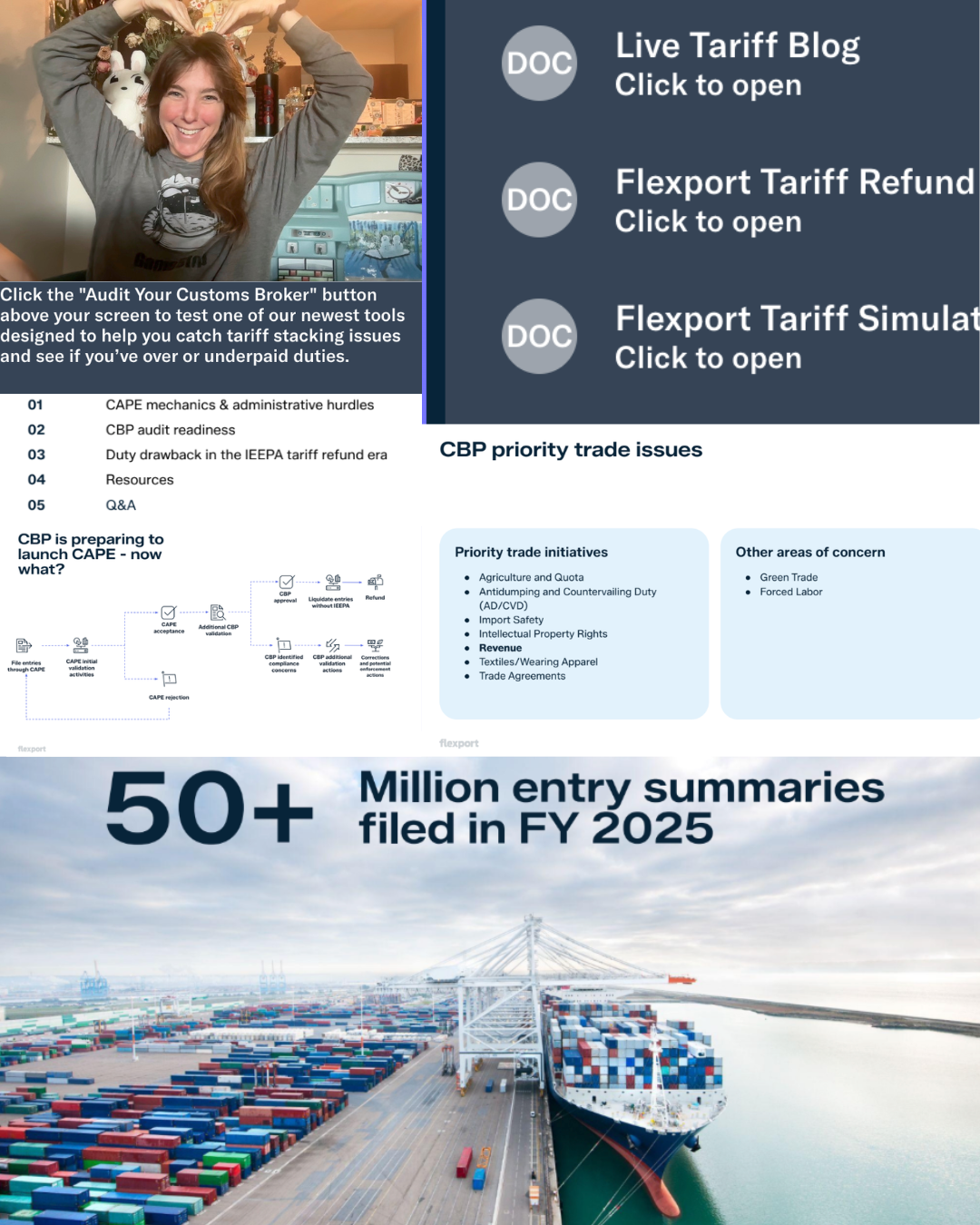
PHOTO COLLAGE AND COMMENTARY:
We’re back, baby! A week later. And again, the Flexport ‘sound check’ for their video calls is classier than ever. Even my daughter commented on it! She was like, “where’s that sound coming from?” and she wasn’t complaining, just asking. lolll. I said “flexport’s seminar on audits”.
Okay so the presentation has begun according to their announcements, but not according to the people. The guy logs in.
A senior trade advisor is leading this seminar. He used to work as a customs auditor.
Now they announce the Q&A section and the end of presentation they’ll address them. BRO no subtitles this time, again. I mean. Let’s see if they fix that one of these days. or maybe tehy like being mysterious.
They have a tarif simiulaator + refund calculator you can try. OMG even a button to audit your customs broker!?!?!??! WOW. I wonder what that is?
It’ll help catch issues, and if you’re underpaying or overpaying
omg but my washing machine is loud - in my bathroom - so i wanna go close the door real quickkk brb.
Okay, I’m back. A guy will join later, head of “drawback” - never heard of that. But it reminds me of “silverback” hahaha
Okay, we’re talking about CAPE mechanics (never heard of that either). And they list what we’ll cover today.
Again the slides have the company colors. Love it
Okay so the launch for CAPE mechanic is on 4/20.
Phase 1 will only process unliquidated entries and entries that are no more than 80 days past their liquidation date
If an entry is 81+ days past liquidation, it’ll be automatically rejected by CAPE Phase 1
Importers or brokers can upload a CSV file up to 9,999 eligible entry numbers directly into the ACE portal to see if you’re eligible for refunds
no clue what this means hahaha
As of February 6, 2026, all CBP refunds must be issued electronically to the importer of Record or their elected Notify party. NO MORE PAPER CHECKS (lol they didn’t capitalize that hahah)
US bank requirements - account must be linked to the ACE portal to receive the refunds
The 4811 two-step trap (he went through it too fast)
CBP audio readiness
What does CBP stand for? I’ll go look it up: U.S. Customs and Border Protection. Of course
Okay, you can download a template and a model, then you place your entries, and they do initial validation activities and make sure there are no duplicates. Make sure there are actual tariffs on there.
CAPE will reject entries for you to correct and refile. The accepted ones, one thing to emphasize, there is a secondary CBP validation step that occurs before you receive your refund.
These are primarily unliquidated entries. In this phase, importers have the burden of proof.
This is the period CBP scrutinizes entries the most, and it’s easy to conduct enforcement.
CBP will look into these closely to determine compliance concerns and see if there are any additional things to review.
Wow, now they have a nice picture of a shipping boat. I’ll take a screenshot. LOL. Last time I don’t think they had a nice pic like this.
Okay - how does customs determine what to scrutinize upon?
- Customs use a risk-based approach to figure out what to look into.
What suppliers are higher risk
agriculture and quota
antidumping and countervailing duty (what’s this?) I’ll look it up:
Dumping occurs when foreign manufacturers sell goods in the U.S. at less than fair value. Countervailing cases are when a foreign government provides enough subsidies and tax benefits for their manufacturers to sell their goods more cheaply than U.S. manufacturers.
Import safety
intellectual property rights
revenue
textiles/wearing apparel
trade agreements
green trade
forced labor (where your parts are coming from, certain countries may have higher products of forced labor) - is this slavery??? I’ll look it up:
Forced labour is any work or service exacted from individuals under the threat of penalty, violence, or coercion, for which they have not volunteered. It is a form of modern slavery affecting an estimated 27.6 million people globally, often driven by debt bondage, retention of identity documents, or intimidation. [1,2, 3,4]
So what? They have certain charges because they don’t allow “forced labor” or they do???
I mean, that’s reality, but wow. I wonder.
We’re going to focus primarily on revenue.
Common factors for determining duty liability
Value
bona fide sale, total cost of production, intercompany sales
Classification
product description, classification history, cargo examinations
Country of Origin
substantial transformation
illegal transshipping (whats this?)
Illegal transshipment is the practice of routing goods through an intermediate country to misrepresent their true country of origin. While legal transshipment is a standard logistical process for transferring cargo between carriers, it becomes illegal when used to evade tariffs, duties, or sanctions. [1, 2, 3]
We see a lot of bad actors trying to claim a different country of origin. It may determine your cap on duties and whether you’re subject to duties at all for antidumping and countervailing duties
We see a lot of suppliers trying to change their country of origin
Makes me think of interns that I’m interviewing who pretend to be from the USA, but they’re totally not.
Trade Remedies
Section 232
Section 301
Antidumping/countervailing duty
“Know your suppliers!” - documentary evidence is key to withstanding CBP scrutiny
Your relation to the supplier may affect the value. Customs get fewer duties potentially and won’t be happy about that.
So make sure that related parties are declared, and if you are related, if they ask for info, support whatever valuation is being declared.
We often see that importers think a transfer pricing agreement by itself is sufficient, but it’s not to prove the valuation. You want to make sure you have all the information needed to prove that the valuation is consistent with customs valuation.
A tariff declared plays a large role in determining what your duty liability is.
Auditors look for consistency in what you’re declaring in your documents vs what is classified as a
question… do importers have a different tax day? Cause tax day was yesterday, so this event is like one day late, right? It must be different. I’ll look it up hahahah:
Importers do not have a different "tax day" for filing income taxes; they must adhere to the same April 15 deadline as other individuals or businesses. However, importers must pay duties and tariffs immediately upon the arrival of goods, rather than once a year. [1, 2,3]
hm… I wonder why this event is TODAY then?? hahah it just lines up so much (almost) with tax day. A cohencidence or intentional?
Methods for validating and enforcing actions:
Validation: cargo examinations + CBP form 28
Initial Enforcement: carto targeting, CBP form 29, detain and seize
Audit: Survey, smell test, professional service/nonaudit, single issue audit, trade audit operations, focused assessment (pre-assessment survey, assessment compliance, testing, follow-up audit)
Other: investigation
FP&F: pentalities
As soon as an inconsistency is identified, we’re going to assume your records may not be accurate, or these are not the documents you’re submitting to customs.
They’ll look and see if there is a risk that needs more review, like an audit
Yeah, this is so cool for Flexport to offer this helpful stuff for their clients/customers. It’s impressive. And smart, a lot of value from this company.
Audits are the highest stage of scrutiny, including your accounting records. Longer and focused. Those can last for… they call them “career-long audits” (can last over 10 years)
So as much as you can, show you are compliant.
CBP is extra interested in anti-dumping and trade (something) over in Asia. How well do you know your suppliers? You may be held accountable as the importer.
Importing from that supplier will possibly get you flagged because you’re importing from that supplier
Focused assessments aren’t as common anymore, but in general, this is the biggest audit you can face. That’s done in 3 phrases:
pre assessment
assessment compliance
and follow-up audits (can continue over and over until you actually fix the issue and prove your internal controls are efficient)
Bro!!! The importing world is so thorough. The stock market/financial world needs to receive this level of scrutiny.
So, what’s the big takeaway? What can you do to prepare as an importer?
To mitigate risk, customs track your history,
Evaluate internal import operations to identify high-risk
Conduct international audits to identify any compliance gaps
determine if gaps are systemic or isolated
correct any compliance issues
Implement effective internal controls to mitigate risk
confirm compliance with 19 USC 1508 (recordkeeping)
Obtain and retain records for the required period (generally five years)
Ensure readiness in case CBP requests documentation
Review records for accuracy and consistency to ensure it passes a “smell” test
PAUSE: i need to make a phone call really quick (my kitchen sink is broken/leaking and my landlord told me to call the emergency number in an email) - okay i’m back
Okay
The challenge is, as a drawback provider, claimant, there are two values… essentially one. Not broken up by HTS or tarrif on an entry line. This means there is no way for customs, within their system, to determine how much of a particular tariff was claimed.
you’d think “at least my drawbrack broker has it” - its possible, but also most legacy systems have a single combined duty rate…
There are times they have two, but if you have claimed on IEPAS, if you’re a drawback customer, we have that split out all the programming once that goes live.
If you’re not familiar with drawback, we won’t drive into that here, but its essentially an exporter incentive program to recover duties that you paid.
can refund up to 99% of duties and fees paid when goods are exported or destroyed
The catalyst is that tariffs shifted the drawback strategy from cool benefit into the core “margin-protection” strategy
IEEPA unlocked manufacturing and petroleum import drawbacks by meeting their duty-paid import requirements
The Supreme Court made a decision striking down the IEEPA, forcing a pivot, creating the streamlined CAPE system
So, there are risks with the 4811. CAPE refunds should go to the importer; in most cases, it does. But a lot of companies shifted to DDP. The entity that bore the costs of the tariffs is not really a party (idk what he said)
4811s to be utilized sounds great, but as Tim mentioned, there’s a 2-step process. You can do that through PDF-based 4811 or get assigned in ACE, or if you have cross-account access, as the top account owner, you can assign access yourself and become a notified party.
Then you’d be really associated with that importer
The additional step is the harder step; you need to be the party listed on each individual import you intend to claim back through IEEEPA. That is a significant hurdle as well.
Basically, the drawback allows you to consolidate a lot of things.
The refund you get has a lot of control.
You have a lot of control over where it’s going.
IEEPA, you get 100% and interest; it’s a great way to go. But one thing to consider is that if you don’t know where the money is going, a drawback may be something to consider.
V1 is allowing you to file anything unliquidated or within 80 days. That includes the 80th day. But 81 and beyond aren’t included in CAPT in V1. And entries filed for recon and those types of things, in those cases… those features are
PAUSE: Now the repair person is calling me. They said this is an “after-hours” call - which is weird, cause its mid-day on Thursday… 10am? I’m surprised that’s “after hours”. They’ll come over soon, but today I’m taking my daughter to the museum (her daycare is closed for the month, so my schedule is weird and my ‘‘weekends” are random). Anyway, back to the show:
Get your data together; you’ll need it for CAPE, get the claims ready. Don’t file it, get CAPE stuff going, understand the payment timeline, then proceed with clarity
OMG lol this is COMPLICATED!!! Can you imagine having to do this stuff?
They’re reminding us of this tool that you can use to audit your customs broker. LOL cool!
You can use this to see how much of a refund you can get back.
You can contact them for help with classification and duty (whatever)
Okay, now they’re diving into questions:
Can a non-resident get an ACE portal and get refunds? (Yes, only with US bank accounts)
If you have multiple (importers? or suppliers) can you do one upload? (yes, across all brokers, but at an IOR level, all the digits, even those last two)
If one importer accounts for multiple IORS, you’ll have to go in and submit applications for that, soon. You can do it across all brokers as an importer. They’ll make sure your first three digits match.
If an importer is filing out CAPE on their own behalf, is K11 (or 4811?) required? Only if you want another party to receive your refunds.
Is it possible to exclude drawback refunds on the 4811? It’s a two-step process. Just assigning someone as the notified party doesn’t do a thing. You need them to be on the transaction. There are different tiers. Bill refunds. Refunds and drawbacks only. A handful of others. Different categories and limitations for the notified party, you elect them to be.
Specific instructions for what is needed for the validation of entries? In general customs, in the case they’re doing additional validation, you want ot make sure you respond to their requests as best as you can. Respond to everything, everything they need>. Translations. A good narrative. Explain everything from beginning to end. If there’s something you’re referring to, make sure you include it -even if they’re not asking for it specifically. Incomplete responses may get rejected entirely.
Partially claimed IEEPA due to export? If a single penny was claimed on one entry line and its not the IEEPA tariff, that means higher entry is not part of CAPE V1
Importers will not automatically be refunded; they must submit the entries to be refunded. Submitted within CAPE, and you must have an ACE US bank account.
They asked for a review/rating. I had nothing clever to say this time, but told them to add subtitles and rated it 5/5 stars.
Oh! I should have told them that pic they used was nice hahaha. The picture of the shipyard ship. And their company colors. The color scheme is nice.
Until next time, I wish you the motivation and success to search for opportunities around your area. Search and explore: Who is out there giving talks? There are new things happening all of the time.
Find relatable or interesting topics you like and check them out! Maybe even something hosted at a cool venue, if there’s no other reason to go. Let’s see what you can learn and discover not too far from home. 😊
