
How I use Hawkins-inspired categories to examine narrative choices at Kelly Tutors.
1. Give the pattern a vocabulary
A chase, a reunion, and an act of protection can occupy the same book while asking very different things of its characters. I want a way to examine those differences instead of treating every exciting scene as interchangeable.
David R. Hawkins’ Map of Consciousness supplies some of the language I use: Fear, Courage, Reason, Love, Joy, and other named states. In my creative work, these become prompts for reading motives, decisions, and relationships.
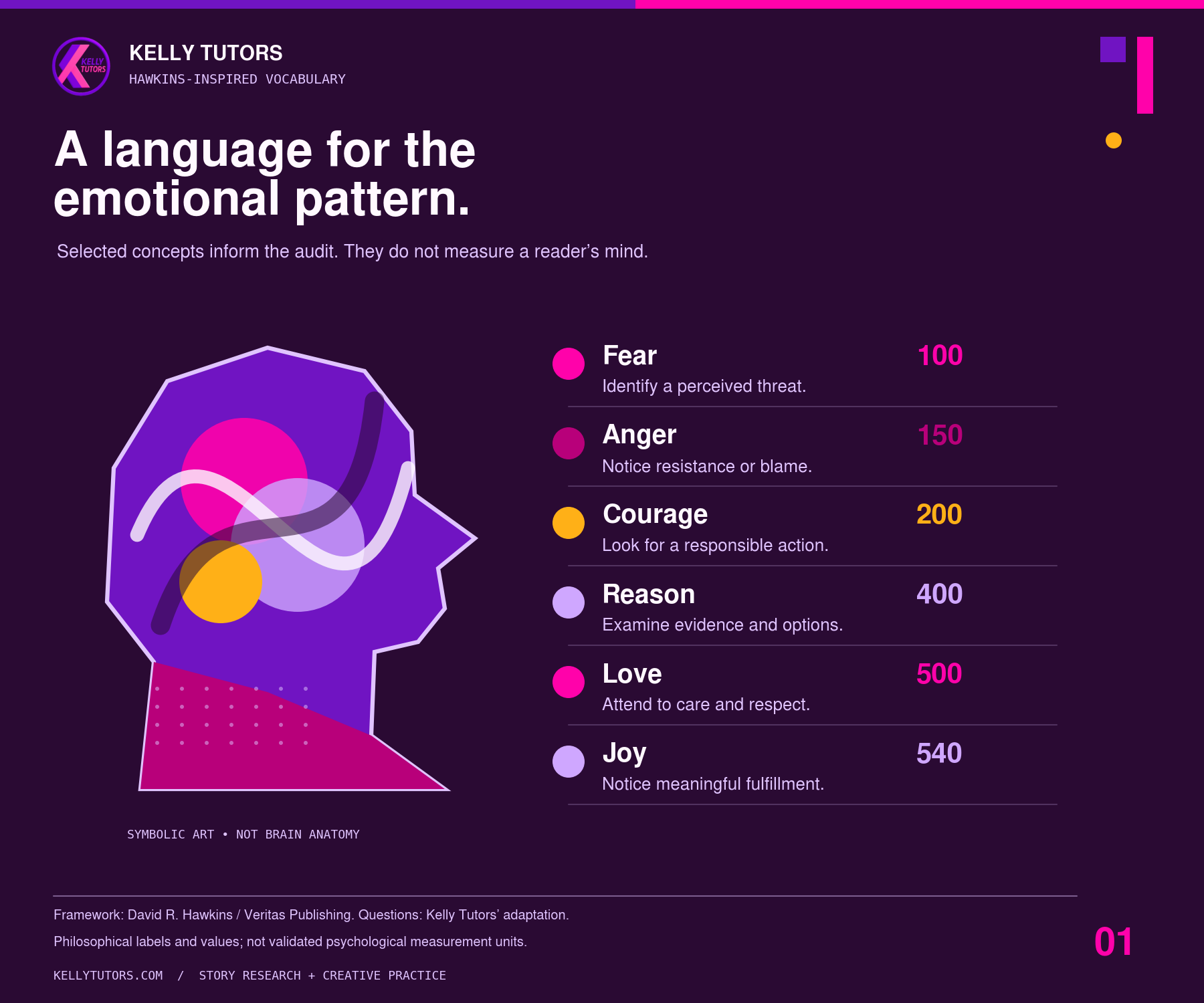
This is an interpretive coding system, not a test of a child’s consciousness. A character’s assigned label describes my reading of that scene. It does not diagnose an audience or establish a biological effect.
The payoff is editorial specificity. Instead of writing “this part feels negative,” I can identify what I see: a perceived threat, an attempt to control someone, a considered response, or an expression of care.
Then I can decide whether that pattern serves the story.
2. Follow the sequence, rather than only the ending
The working chart for The Happy Gingerbread Man identifies 15 key moments, from the initial welcome through the closing reunion. Each is paired with a Hawkins-inspired label and a page reference.
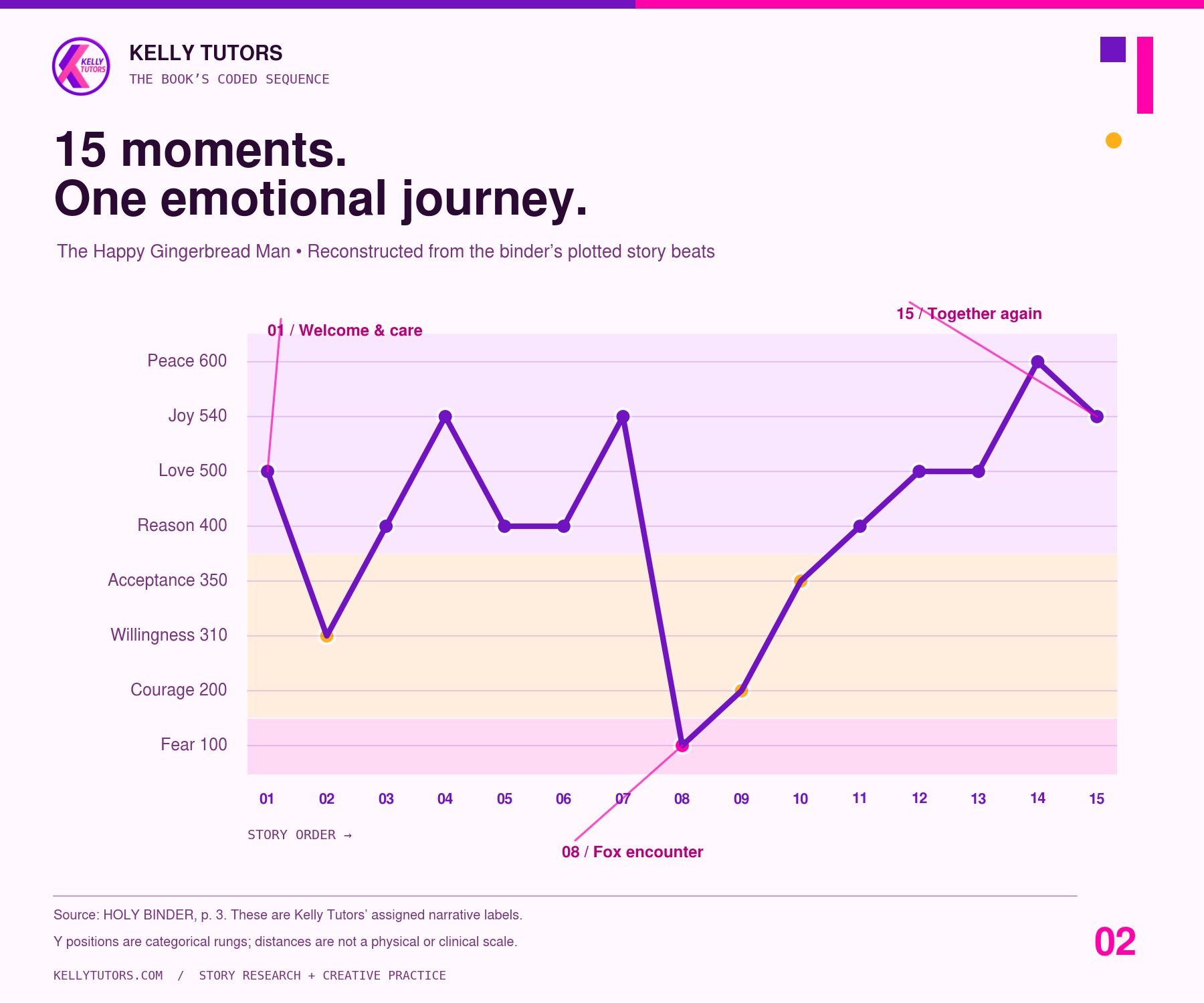
That sequence tells me something a happy final page cannot. It shows where the narrative pauses to learn, where friendship develops, where danger enters, and what follows it.
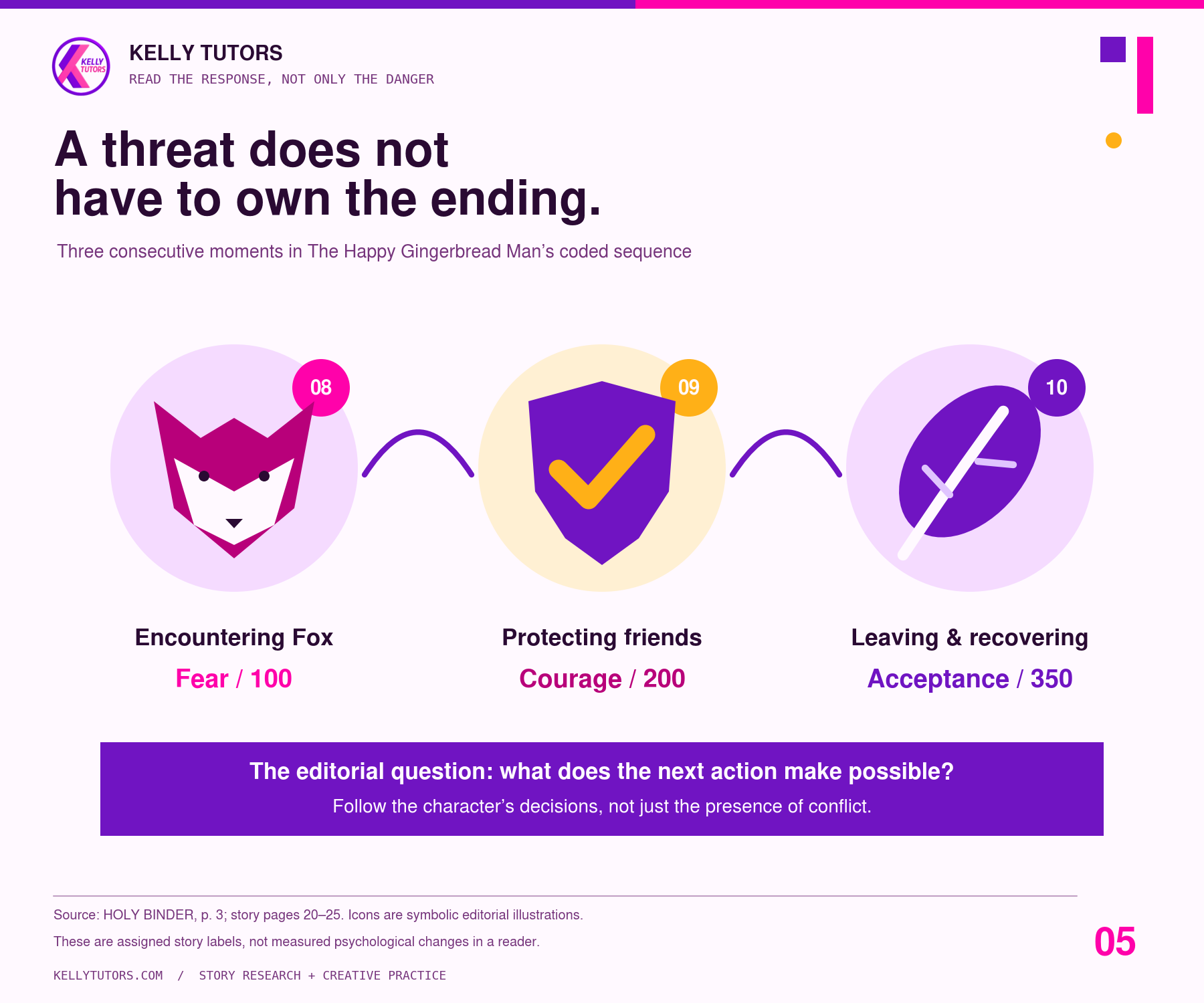
The fox encounter is the eighth selected moment, assigned Fear / 100. The next two are protecting friends, assigned Courage / 200, and leaving and recovering, assigned Acceptance / 350. The ending later includes Love, Peace, and Joy.
These are my classifications of events in a story, not measurements taken from readers. Even within that limit, plotting the observations makes the creative argument visible: tension occurs inside a larger pattern of connection and response.
3. Put the counts underneath the percentages
A summary number should be traceable to the observations behind it. Reconstructing the 15 plotted moments produces this breakdown:
1 of 15, or 6.7%: below Courage.
3 of 15, or 20.0%: Courage through Acceptance.
11 of 15, or 73.3%: Reason and above.
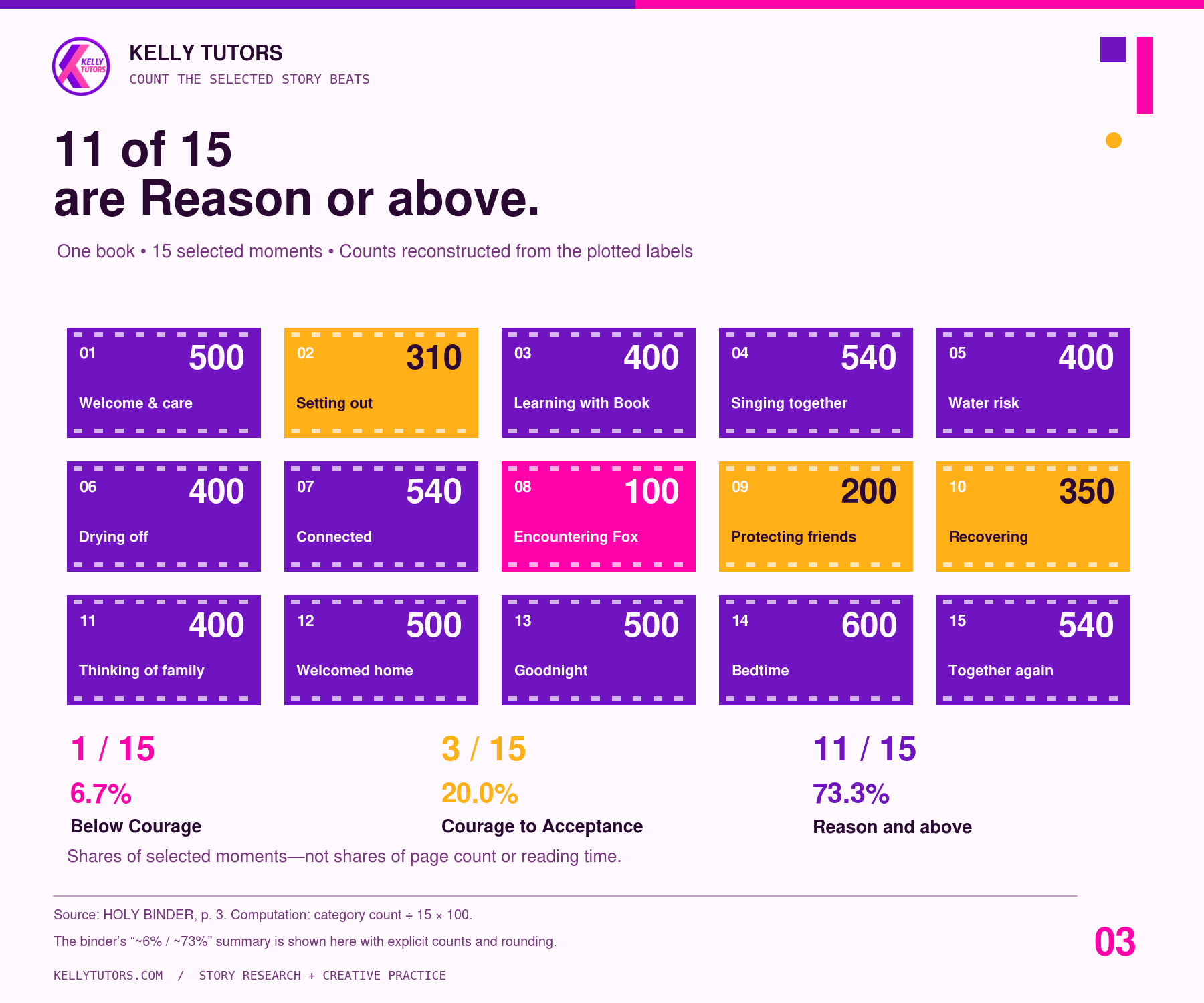
My earlier working summary used approximately 6% and 73%. Showing the actual counts makes the rounding clear and exposes the denominator: fifteen selected beats, each counted once.
These figures describe neither the proportion of pages nor the time a child spends reading. A brief moment and a longer sequence each contribute one observation in this particular chart.
For me, the useful finding is concrete: most of the selected moments in this assessment involve reasoning, care, joy, or peace. The numbers make that creative emphasis inspectable; they do not prove a developmental outcome.
4. Compare profiles without pretending every story is the same
My working materials also contain assessments of family films. The ribbon graphic brings five of those examples alongside the book’s reconstructed profile.
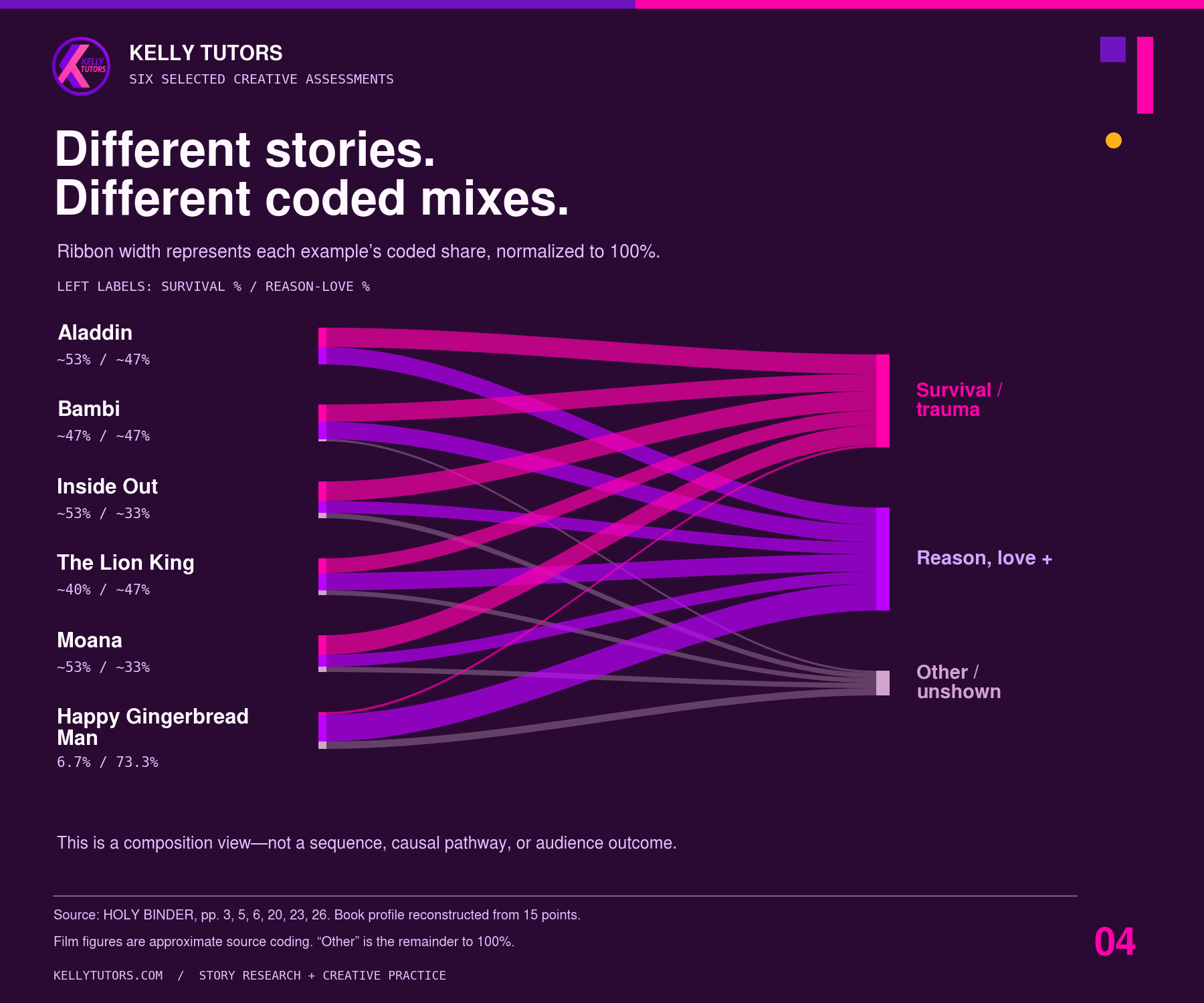
The source summaries assign roughly 53% of selected moments to survival/trauma in Aladdin, Inside Out, and Moana, compared with roughly 47% in Bambi and 40% in The Lion King. Their reason/love groupings differ as well.
Those are approximate internal assessments, not published clinical findings. They depend on which moments were selected and how they were classified. The book’s displayed percentages come directly from its 15-point chart; the film percentages retain the rounded working summaries.
The ribbons show composition, not movement between emotional states over time. Their purpose is to make an editorial comparison easier to examine.
A stronger research comparison would also require consistent selection rules, accessible coding records, and independent reviewers.
5. Use the audit to make a better creative decision
For my writing, the most revealing part of a difficult scene is often its aftermath.
Consider the three adjacent moments around the fox encounter. The assigned labels move from Fear to Courage to Acceptance. That is a useful place to ask what the character and companions actually do: respond to the danger, protect one another, and recover.
I’m not trying to eliminate emotional difficulty. I want to examine whether characters receive meaningful opportunities to exercise judgment and whether those choices affect what comes next.
A Hawkins-inspired audit helps me locate the scenes worth revising. Perhaps a character needs information before acting. Perhaps care needs to appear through conduct rather than a declaration. Perhaps the resolution needs to acknowledge a relationship that was damaged along the way.
That is how the framework becomes part of authorship at Kelly Tutors: a way to notice patterns, explain creative choices, and keep improving the work.
Explore the books and projects at Kelly Tutors.
Read more on all of this: https://www.kellytutors.com/blogs/ai-week-booth-with-kelly-tutors-at-bell-harbor
