
1. Start with what is on the screen
When I examine children’s entertainment, I want to make the creative choices visible.
What starts the adventure? What happens to the caregivers? How often does danger supply the momentum? What opportunities do characters have to learn, cooperate, or repair a relationship?
Those questions shape my work at Kelly Tutors. They also require care: identifying a recurring theme and demonstrating what it does to a child are different research tasks.
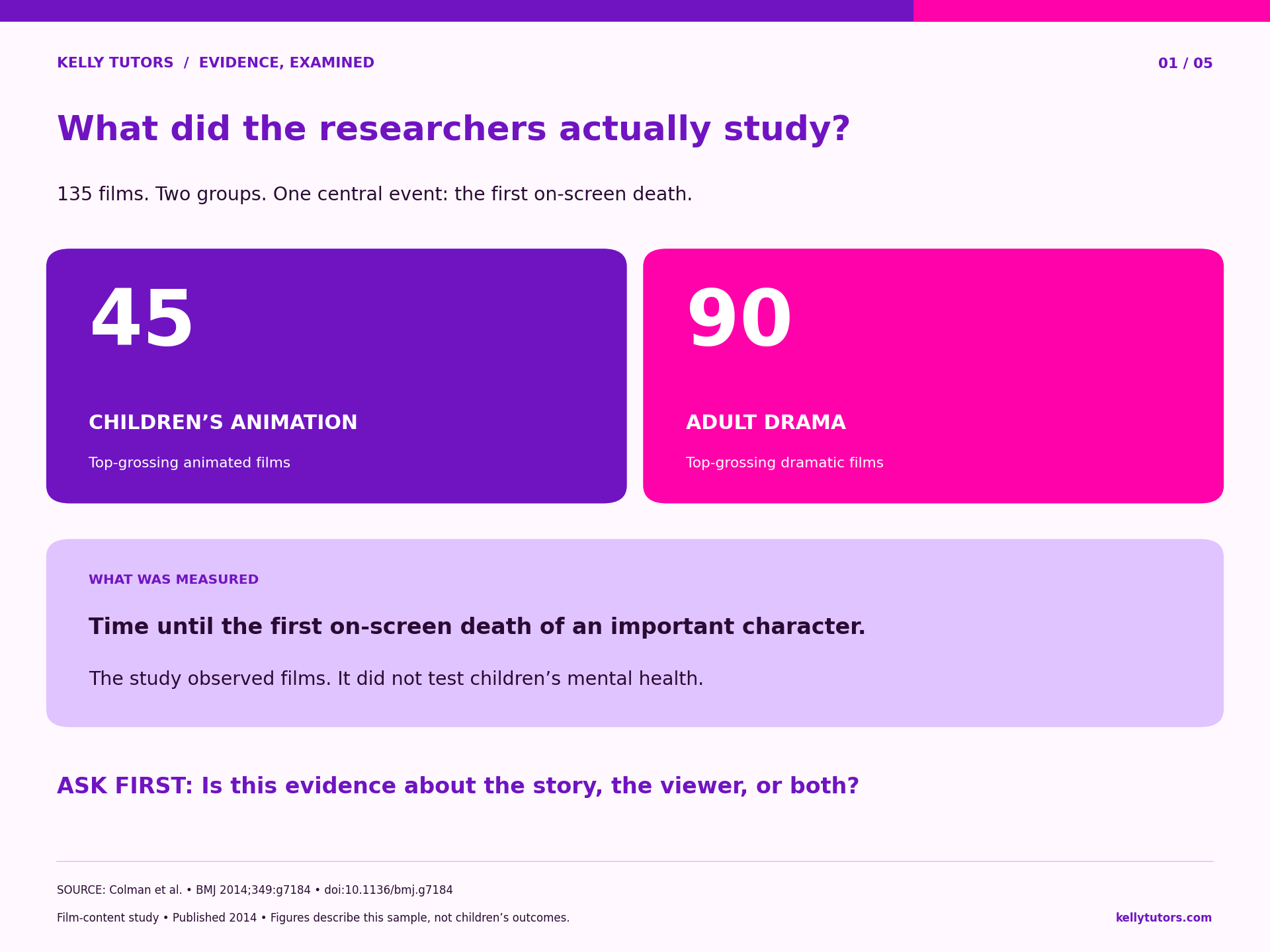
The 2014 BMJ paper “CARTOONS KILL,” by Ian Colman and colleagues, offers one starting point. It compared 45 top-grossing children’s animated films with 90 adult dramatic films, examining the time until the first on-screen death of an important character. pubmed.ncbi.nlm.nih.gov
That gives us something specific to investigate. We can examine what the stories contain, how those choices serve the plot, and whether we want to keep relying on the same devices.
2. Read the percentages with their denominator
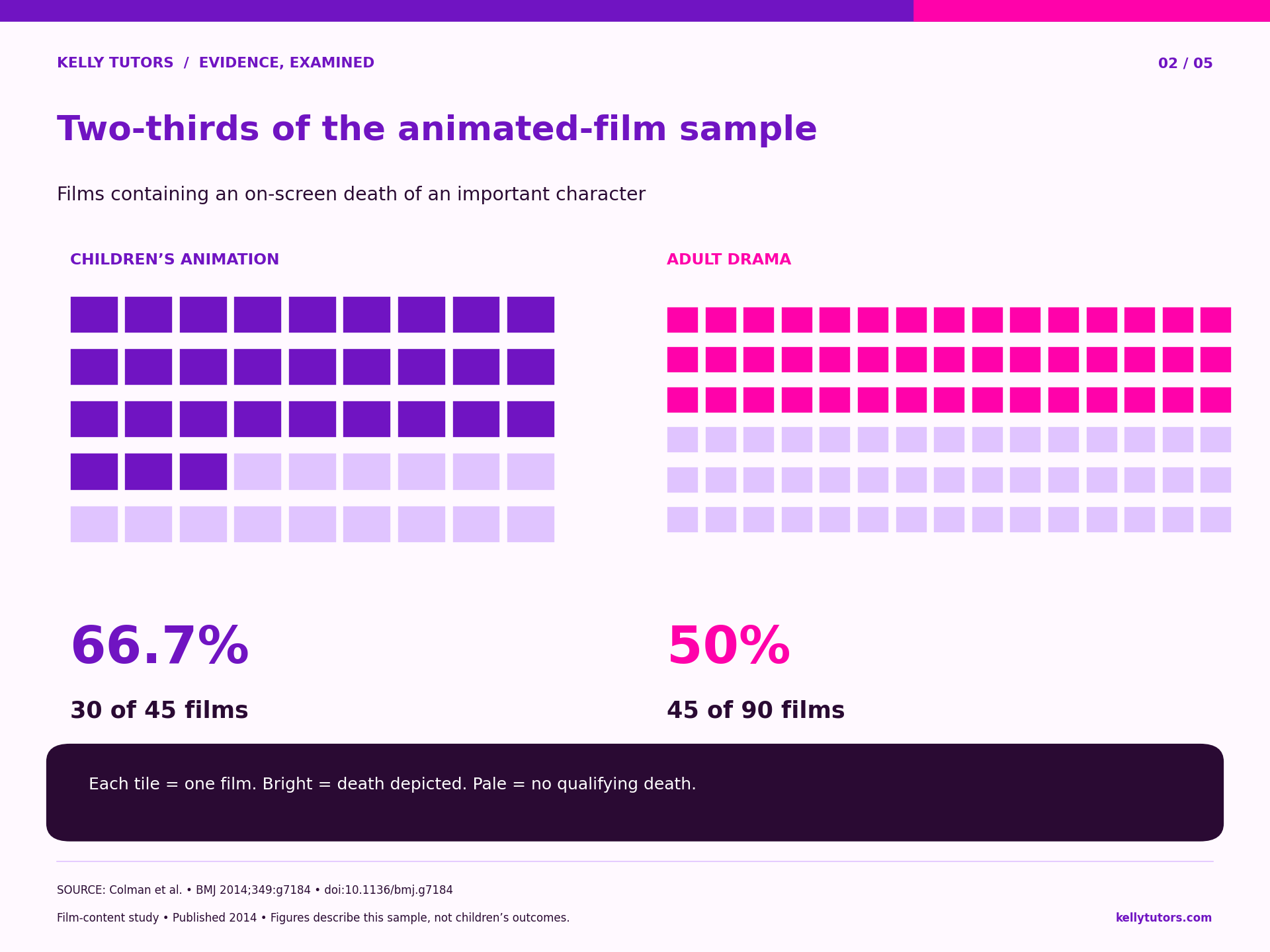
About two-thirds of the animated films included an on-screen death of an important character, compared with half of the adult dramatic films.
In sample counts, that is 30 of 45 animated films versus 45 of 90 adult films. The difference is approximately 16.7 percentage points.[1]
The denominator matters. These are percentages of films in the sample. They do not describe the percentage of children who became frightened or experienced trauma. They also do not mean that two-thirds of all characters died.
For me, the finding raises an editorial question: why is death such a familiar ingredient in entertainment presented to children?
A loss can serve a meaningful purpose in a story. It can also become a convenient way to remove a caregiver, create immediate stakes, or send a young protagonist into danger. Looking closely means asking what each particular story does with that choice.
3. Understand what the hazard ratio measures
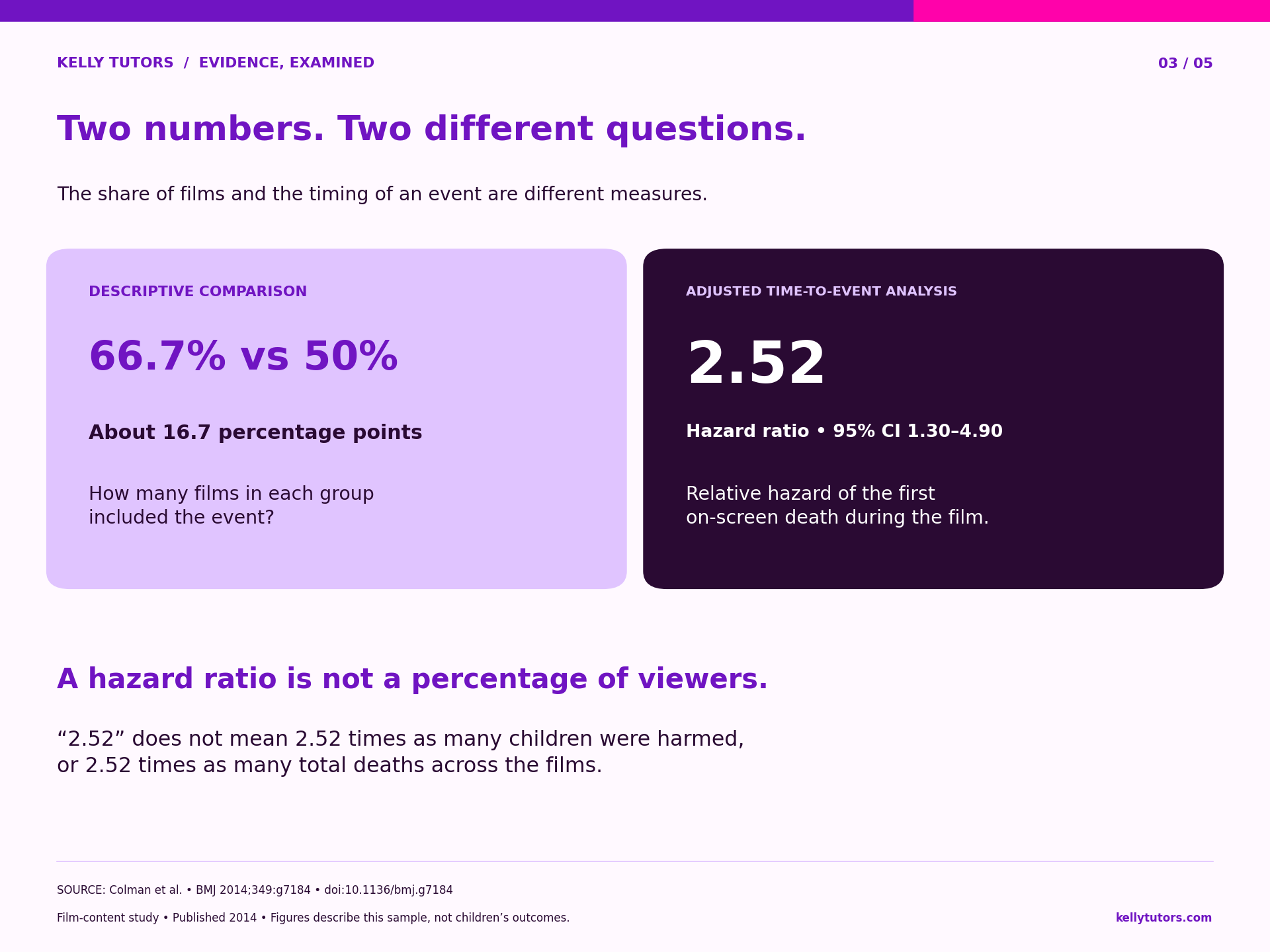
The study’s adjusted analysis reported a hazard ratio of 2.52, with a 95% confidence interval of 1.30–4.90, for the first on-screen death in animated films compared with adult dramas. pubmed.ncbi.nlm.nih.gov
This measure incorporates when the event happens during a film. It is different from counting the share of films containing a death, counting every death, or measuring an audience’s response.
A scene raises several distinct questions:
What happens?
How does the story frame it?
What does a particular viewer understand?
What does that viewer experience afterward?
Examining the film helps answer the first two. Understanding children’s responses requires evidence about children.
That distinction also applies to my own research. My story assessments examine selected narrative moments and their emotional themes. My Hawkins-inspired vocabulary serves as a creative and philosophical lens; it is not a clinical assessment of viewers.
I want to keep asking ambitious questions about media while being precise about what each kind of evidence can establish.
4. Give the parental-death estimate its full context
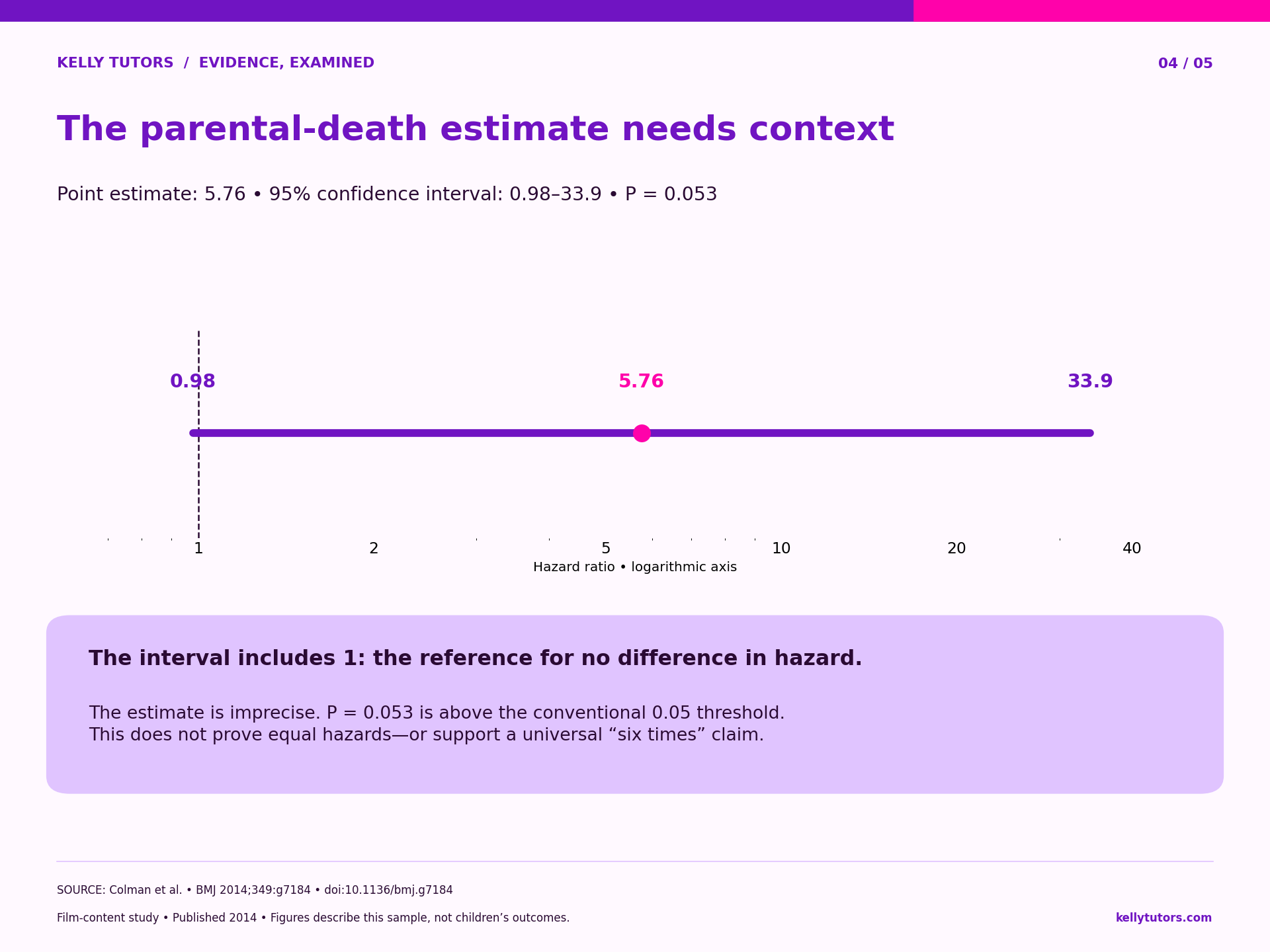
One particularly memorable number from the paper is the parental-death hazard ratio of 5.76.
Alongside that estimate, the researchers reported a 95% confidence interval of 0.98–33.9 and a P value of 0.053. www.bmj.com
That interval is very wide and includes 1, the reference value for no difference in hazard. The result did not meet the conventional 0.05 statistical threshold.
It deserves more careful wording than a universal claim that children’s films have “six times more dead parents.” It also does not establish that the groups were equivalent. The estimate carries substantial uncertainty.
The question remains worth asking: what role does parental loss play in the stories children encounter?
We can examine whether a loss receives thoughtful attention, whether grief has room to unfold, and whether a character finds dependable support. Those details matter to the story we are choosing to tell.
5. Turn the question into a creative decision
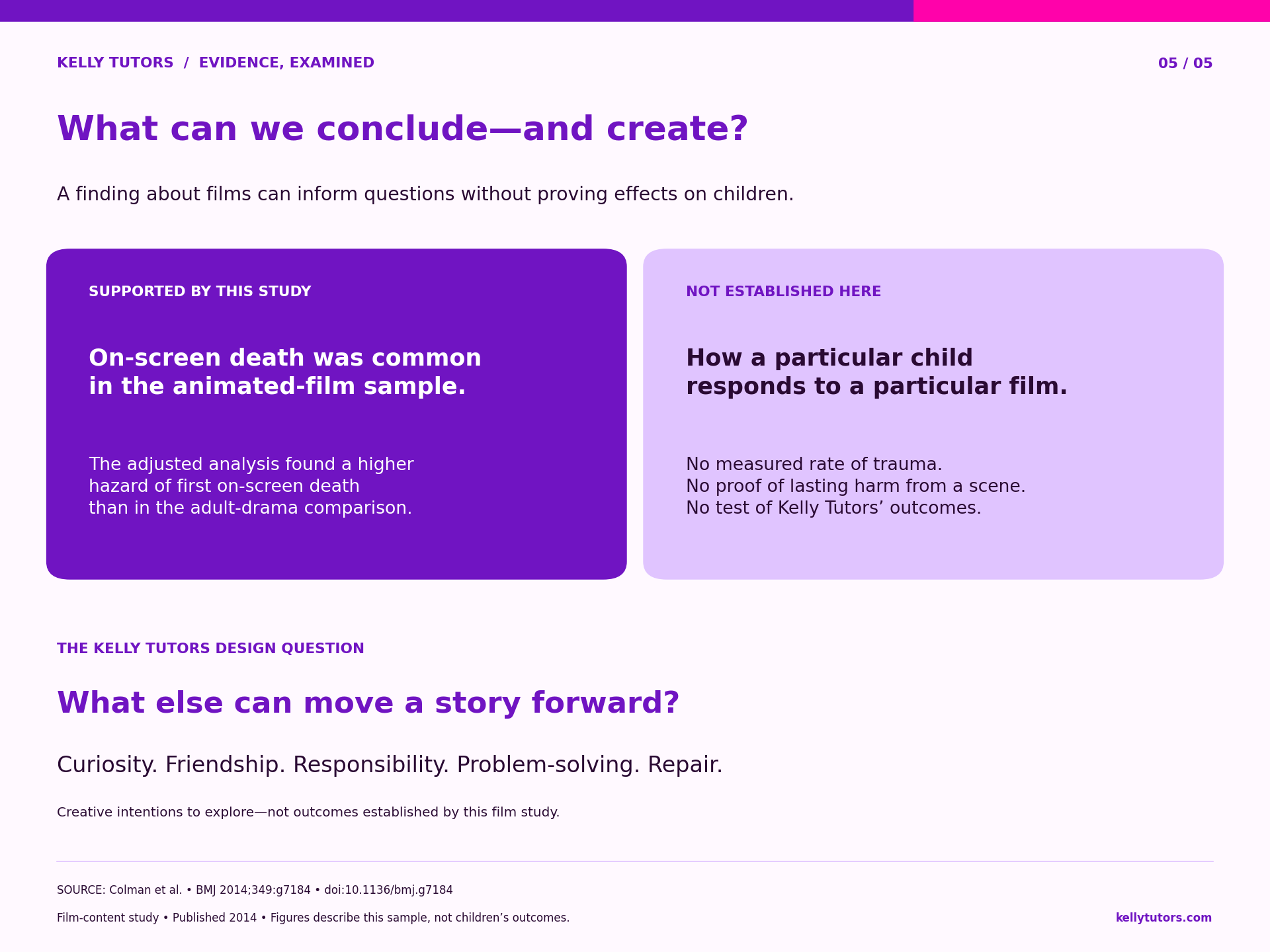
For Kelly Tutors, the practical response is to expand the kinds of challenges a story can offer.
A character might need to learn a difficult skill, understand an unfamiliar neighbor, negotiate conflicting needs, correct a mistake, or figure out whom to trust.
Those situations offer stakes, humor, frustration, discovery, and satisfying change. A story can move through curiosity, responsibility, friendship, and invention.
In The Happy Gingerbread Man, my creative emphasis is on friendship, problem-solving, boundaries, and returning to connection. Those are the experiences I intentionally make central to the narrative.
When I audit a story, I ask:
What creates the tension, and what purpose does it serve?
What choices can the character make?
Who offers reliable support?
What happens after a frightening or painful moment?
What does the resolution give the audience a chance to understand?
Stories can make room for grief and difficult realities while also showing care, recovery, and meaningful action.
I want children’s entertainment to offer a wider range of ways to grow. That begins with examining the patterns we have inherited and making deliberate choices about what we create next.
Want to help fund that mission? Become a Funding Founder.
Explore the stories and the questions behind them at Kelly Tutors.
[1] Colman I, et al. CARTOONS KILL. BMJ. 2014;349:g7184. Read the paper.
