
Proposing to the White House: Unmasking Manipulation Through AI Education
Disclaimer: Everything below is a mix of what I observed and heard during the event. The goal isn’t to pinpoint "who exactly said what," but to share (usually) an outsider's view and overall perspective on these industries. I’m not here to act as a definitive firsthand source—readers should do their own research. I hope this inspires you to attend events, explore new industries, and hear what leaders are presenting. These notes combine my observations with thoughts on how things could run smoother and how ideas connect (IMO). I’m not an expert, you know? Just hanging out in the room with them. Enjoy!Topics:Education for Youth, Children’s Media, Compliance, Manipulation, Algorithms, Propaganda, Child Safety, Teachers, White House Initiatives, AI Education, Innovation, Contests
Congratulations, me!! It has been eight long months, and this project/proposal is finally ready to be proposed. Will Trump’s team say “I do” and bring me onto the second round of this contest? Well, that depends on how well the other educators in my region did on their proposals. This is a contest, after all, so scores matter. I have worked super hard since the week the White House’s Presidential Action was announced last Spring. And I’m done with my work. My mission is to help kids/families/teachers identify the way they’re being manipulated and messed with in real time, to provide them with information (not just censorship) to make informed decisions for themselves. Will it be well received, let’s see!! That’s up to the judges.
Why Attend: I joined this contest for a number of reasons. Mostly, I really want to help the world. As crazy and huge as that sounds, it’s the truth to my core. I see lots of problems in children’s media, teen media, media overall, and our society. Normalization of sexualization and binge-ing and consumerism and just overall complacency that I think people don’t realize they’re hypnotized by. And if/when we ever question things, often the one questioning it is called “crazy”. Yet, one of my favorite quotes is, “When a brave man takes a stand, the spines of others stiffen,” and already since putting my video on YouTube (my video summarizing my project) it’s getting good feedback. A number of passionate comments in the comments sections, from random strangers! So, it shows me - which I already could have guessed/researched, people want change. They won’t want their kids (and themselves) to be so manipulated by algorithms which are just there to make people spend more time on these platforms - not actually get smarter/wiser from it. Its time wasting and grooming in many cases. I believe that showing this to THE WHITE HOUSE is one of the most direct ways i can influence change and show “the world” thatpeople are catching on and want to see better options.
Photo Collage and Commentary
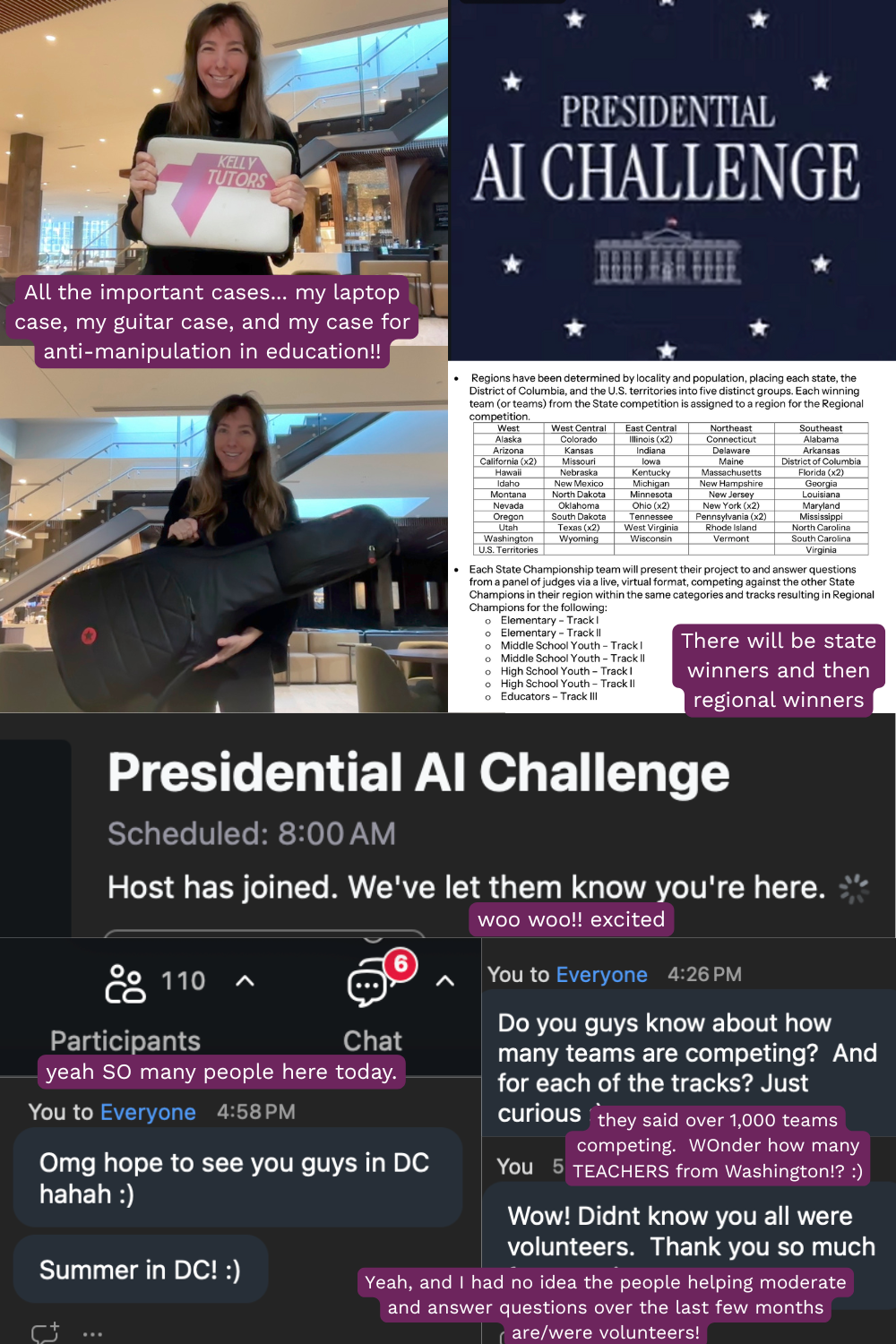
Notes from the Event:
Today is the last “office hours” which I’ll write notes about below… and then further down, I’m going to just put my actual proposal. They said we can make this all public, so lemme go for it. And then before I attend the office hours, I’ll be busking again today. So far I’ve made $600 in less than two weeks!! That’s really surprising and fun to me, since I really love singing, I just improvise songs (so it’s actually a fun challenge for me), and I’m literally surprised every time someone gives me a tip… I underrate myself. But it’s a super good creative outlet that is checking so many boxes at once: happiness, creating, bravery, tenacity… I’m even testing out different outfits and different spots around the city to see what works. Some days I try three or four different spots till I find one that works. Plus, FIFA will be here in a few months, so I want to find the best chances of entertaining people and getting good tips. It’s really fun and the best side gig. It helps me not feel so lonely, too… lol/for real.
Plus, look down on busking all you want - but our new mayor used to be a busker!! So… it’s not like it’s hurting my future at all, may even help me be mayor one day. AND I’ve had two people come up to me and say they recognize me from busking in 24 hours… lol… so (actually, that is the worst part of all of this. A lot of “who I am” lately loves being anonymous, especially since standing out SO MUCH in Shanghai… it’s actually extremely nice to blend into the crowd, I realize. But that’s even a motto in China… like, just do your best not to stand out and fit in. I see its value now. Though standing up and being a leader is great, too. I just like when it feels earned/deserved. Not for superficial reasons - and this of course makes me think of how much I hate my birthday and the forced/obligated attention from your birthday… like the one day a year people go out of their way to talk to you. I wish birthdays would disappear and people would just show their real feelings. If they only talk to you once a year, don’t bother. It just makes me feel more lonely.)
NOTES FROM THE FINAL OFFICE HOURS:
Over 100 people in the final event. Wild!! This is so many people here. Not so surprising, but just a few weeks ago it was only like 2 people in the room with me.
This meeting is super chaotic. People are showing up looking for other people in a room. All sorts of chaos going on.
They’re dividing people up based on if they have questions about AI or Admin stuff. I’ve decided to go to the Admin rooms since it’ll probably be more general.
Omg people keep turning on their mics and waiting to be added so impatiently. It’s so funny/surreal how the admin are staying calm. They’re like “we’re going as fast as we can” to move people. And people keep interrupting her flow asking to be moved. But it’s like, of course you guys - be calm.
I literally put instructions in the chat since many people are like, “we don’t know how to change our own names” and they’re not even following the instructions. They keep interrupting her and being impatient. LOL - at the same time this could maybe be better… but it’s like omg these people attending have no idea how to attend a zoom meeting, they keep interrupting and not following hte instructions. It’s so insane hahaha. I’m like trying to help. This is so chaotic and annoying. How no one is following the instructions.
We’re already 15 minutes into the meeting and they’re still sorting people out. There are still 61 people left waiting to be put into rooms.
People keep interrupting and introducing themselves.
LOL like one guy is like “I changed my name” but he just literally wrote his own name.
So funny and crazy. So many people procrastinated. I’m already done, just wanted to join to learn and see if anything random/useful comes up in this final office hour. But okay - I’m invited to join a room . There are only 40 people left to sort out, so I’m gonna go there.
There are 17 people in my group.
They’re saying you only submit one thing - your PDF. Your video needs to be embedded or a link in the PDF.
The posters are only for the younger tracks. The older tracks need a video. There are lottos people with questions. One girl asks if the 500 word minimum requirement is okay, but written as a research style… with findings, results, and discussion… is that format recommended.
-Just make sure its 12pt font, 10 pages… just follow the base guidelines.
Next question is wondering if the certification of originality is part of the 10 page document.
The certificate of origination is a checkbox that the adult submitting it has to check. It’s confusing cause it says it is a certificate, but it’s not. It’s a checkbox.
Next question: on the guidebook, rulebook, page 8… when you submit it, you can also enter the challenge submission to get additional prizes for the state and region. Where do you opt in for this?
Some people are going to submit but don’t want to be part of the competition. So when you submit… he said he’s not 100% sure if there is a checkbox or a way to say you’re part of hte competition or just submitting to get judged. Not be part of the competition.
I want to be a part of the competition
And the judges aren’t sure or clear on this. This may be where you just email and confirm… and now she’s going to go find out the answer and then be back.
They’re asking if its okay to submit it now or wait till she comes back (like wait 5 minutes lol)
Okay now this next guy has a questions, asking if the narrative has to be double spaced. It’s not mentioned in the guidebook. Just 10 pages or less.
One girl is shaking her head.
12 font or larger, won’t need reading glasses… but if students pack more info and go single space and still fit the 10 page, 15MB max, maybe some are wordy enough. Would that be okay to the judge? Yes, it’s acceptable. If it doesn’t say you can’t do it, then you can do it.
Along those lines, can you embed graphics and illustrations within it? And for works cited, there’s not specific guidelines, right?
No, just copy the URL and insert it. Something like that.
This guy thanks them a lot for all of this first year orchestration. Lots of excitement.
Now someone says they submitted it a while ago, but they want to make sure anything else needs to be done, or if you submitted it are you all done? You’re all done.
Next question is wondering if anyone can help them. Cause she’s worried her page is too big in file size, but it may be too big. But he says - no, if it’s all text, it shoudl be fine. OMG maybe I shoudl try to submit mine right now mid-meeting. I’ll try. (Actually, they said you can email them… so I’ll try to do it tonight, after hanging out with my daughter- like late tonight) then if I have any questions I’ll send it before midnight tonight.
Okay, back to the voluntary submission… for everyone submitting a project, you’ve all done one for hte challenge. T hen the adult supervisor says - do you want it to be judged for the challenge… if so, yes, they move onto the next phase and competing for your state/region/nationals. Anyone saying “no”, if it’s eligible and compliant, you only receive a certificate.
So you submit it only in one place? Yes - and one of the last questions is if you want to enter the challenge or not. If “yes” you compete against other people in your state. If you win regional, then you get onto nationals.
Wow!! Exciting. I wonder if there are lots of people competing from my state? Who knows!! Crazy.
I asked. “Do you guys know about how many teams are competing? And for each of the tracks? Just curious :)”
Now this girl is asking about turning AI into semiconductors. Wow! And she asks if it’s still eligible for the contest (you’d hope so, right!? It’s a little late to ask) and they say 100% it’ll boil down to your narrative and make it as clear as possible.
Next girl is asking about the PDF format… does it need to have a title? Or author name, background introduction like a research style paper? Or is it just like an essay?
They said they’d suggest… it’s up to you. But maybe leave your name off of it. (Uh oh, I put my name on it). They said its personal preference what you put on there.
The judges will see your submission. But put the most important thing you want to communicate as the project front and center. It’s not required or necessary, it’s personal preference. You just want to communicate the solution and the problem you’re solving as clearly as possible.
And after submission, do you wait for an email? Yes - they’ll send you an auto conformation email once you submitted it.
They said it’s okay to leave it off, or leave it on (the names) it’s absolutely fine. Just do your preference.
They’re asking who has any more questions. One guy said he has questions and was a last minute submission to the question. One guy is submitting from Beijing? What hte heck… is this allowed internationally?
Now they’re calling on each person one by one to see if anyone has questions. I’ll just ask about their plans for answering emails tonight. If I have last minute questions, will they get back to me in time?
He says to review: look at hte guidebook, rubric, know your track and follow them as a guide. Then there are questions in there, guiding questions, try to answer those. The judges are going to look for the student’s voice, authenticity. Why this project is important? Why was this chosen? Add as much as possible so that the judges know as much as possible. You can’t assume it’s obvious. TELL the judge, make sure things are in there. Air on the side of caution.
One girl says if your project is more complex and technical with AI, is it better to express it more like a research paper or more of a narrative student voice?
The White House team says to make it more of a narrative instead of technical. The student voice shoudl shine but it’s a combination.
If you have to weigh one more than the other, the student voice/narrative is heavier.
If you have 13 pages, have an AI bot help you cut it down and clarify… get it down to 10 pages.
One lady asks if there is a phone number we can contact? No - use email and they’ll respond. They’ll have a hard time responding any other ways.
Any advice for the group? Commentary?
The marketer in her wants you to think through why you built this… the problem you’re solving, the tools used, the human element of how you’re using these tools, and make it clear.
I’d pit in the last few hours - with an AI LLM get help polishing and refining it from there. Be as crystal clear as you possibly can on the problem you’re solving, your thought process, and how you’re thinking… using the human-in-the-loop with AI. It’s really going to help you. It’s marketing. Market yourself. Be a sales person for yourself.
Wow! Over 1,000 submissions from around the country. The idea isn’t winning and losing, though, but the learning going on. How this learning will keep you excited. There are going to be lots of opportunities from this. Lots of opportunities and jobs out here, different from now. This generation has a real challenge/opportunity to help formulate the next generation of business of work in the USA. It’s going to be different than what it is right now.
Judges are going to do a lot of these, they’re not going to spend a lot of time trying to figure out how to get access to your link.
Test that your links work.
Next guy has a couple of questions. Wondering if there are rules on attaching code indexes on PDF. Then the link opens up in the web browser and that link contains more codes that link to PDFs.
Judge by judge basis and curiosity and time. They’ll click the first link, but going two or three links in, can’t guarantee. Try to make it all one link if possible.
The more you’re asking judges to move around and figure out what is important, the more they’ll make up and think what is important. You need to be clear on the priority and focus.
If it’s vital to the story you’re telling, put it in the forefront.
LOL one guy wrote in the chat: Yes, Kyle. This initiative is fast-tracking AI in education quicker than I’ve seen anything in the past 40 yrs in computer science education…PC’s, early dial-up connections, WWW, broadband, Web 2.0, early era Blackberry Nokia flip phones, iPhone vs Android, social media 2.0, etc…pretty exhilarating for sure…$10000 prizes don’t hurt either LOL
The title… does it have to be a certain amount of words? One word for the project? Or five or ten words to describe it as the title
Lol thats a funny questions.
They say this is a personal preference.
They said at least 2 or 3 judges will look at each project, there are “lots” of judges, and they’re not sure how many projects each judge will look at, just depends how many are submitted. But definitely it will be (hopefully) three judges per project.
And someone is asking what technical level is each judge? There will be at least one extremely technical judge per project- maybe even two… (oof. Idk how technical my project is hahaha).
They’re not sure how the score will work… maybe an average or a team decision.
What can we expect after submitting our proposals?
Then the next 10 days will be a verification period… verifying they all meet the requirements, then they’ll go out to be judged.
Then the deadlines are in the guidebook… March 16th - April 1st, the state winners will be announced. Then March 27-April 13 will be the regional competitions. Then those will be announced May 1st. Then June 7-10 you get to travel to DC.
They said thanks to everyone. Polite, cordial…
Everyone is thankful and happy. LOL and we go back to the main room and a girl is asking about hte GUIDEBOOK? SHE DOESNT EVEN KNOW IT EXISTS hahah. Oh geez. That has been around since day 1…
Now they’re asking if you count the cover as one page…
Yes, the cover is one of your 10 pages. LOL.
One girl asks if we should include vocabulary or standards if you have the space.
OMG what? Vocabulary and standards? Ahh - should I add that last minute? Maybe.
Wow! They’re letting this event go late.. last week they ended it right on time. That’s good to see.
WOW and they say thanks so much to the volunteers. Wow, I can’t believe they were volunteers.
They’re saying if you make it to the next level of rounds, you get to add onto your submission and improve it. GOOD!
Okay… I feel so exhausted from today - in a good way. I made like $70 in an hour busking by the waterfront!! It was awesome. I’m happy with the success I’m having busking. Mostly, it’s just super fun.. .nice to get outside… be creative… it’s amazing.
I’ll take a small rest before meeting up with my ex and my daughter. Grateful for this experience!! I hope my submission is a winner - or at least appreciated.
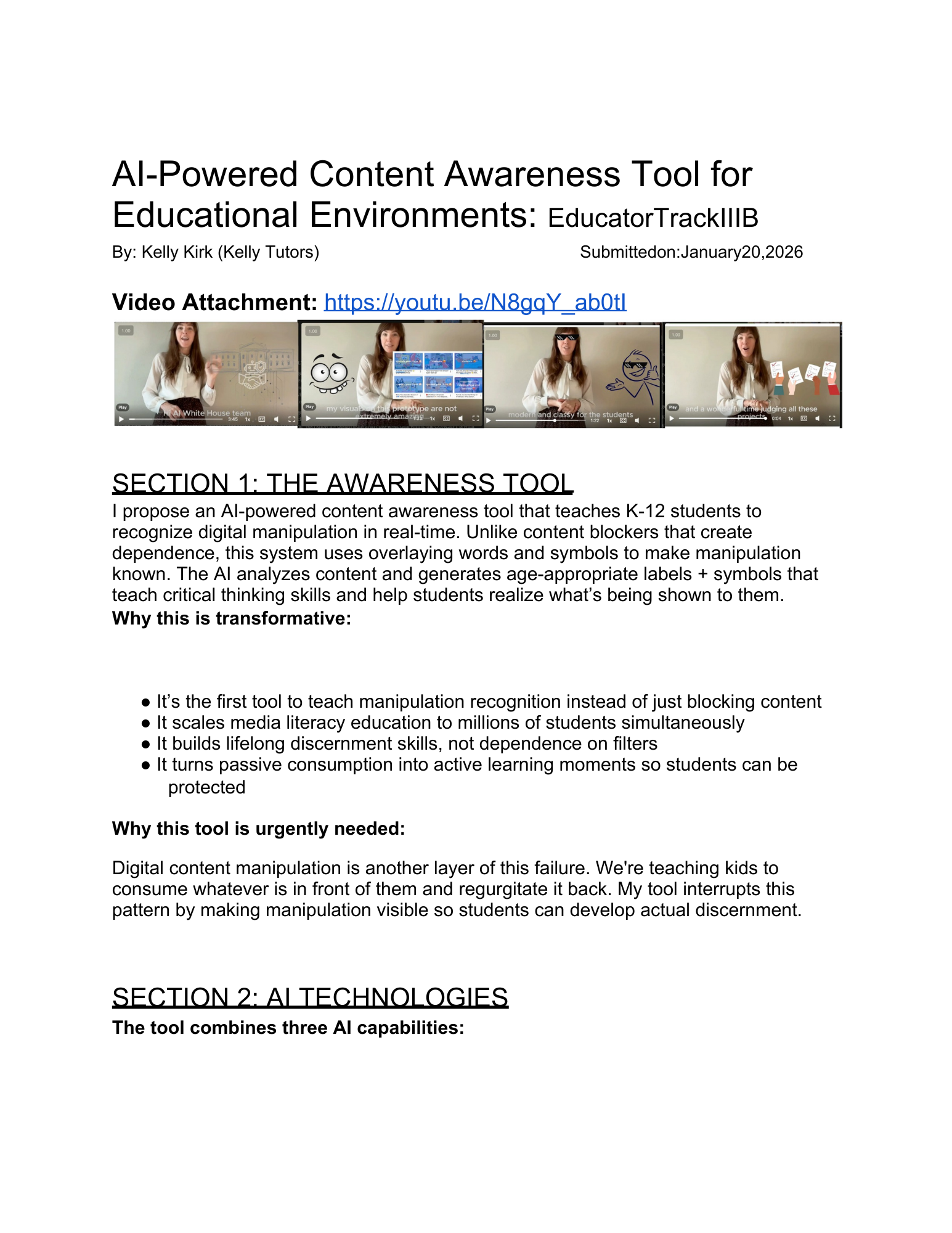
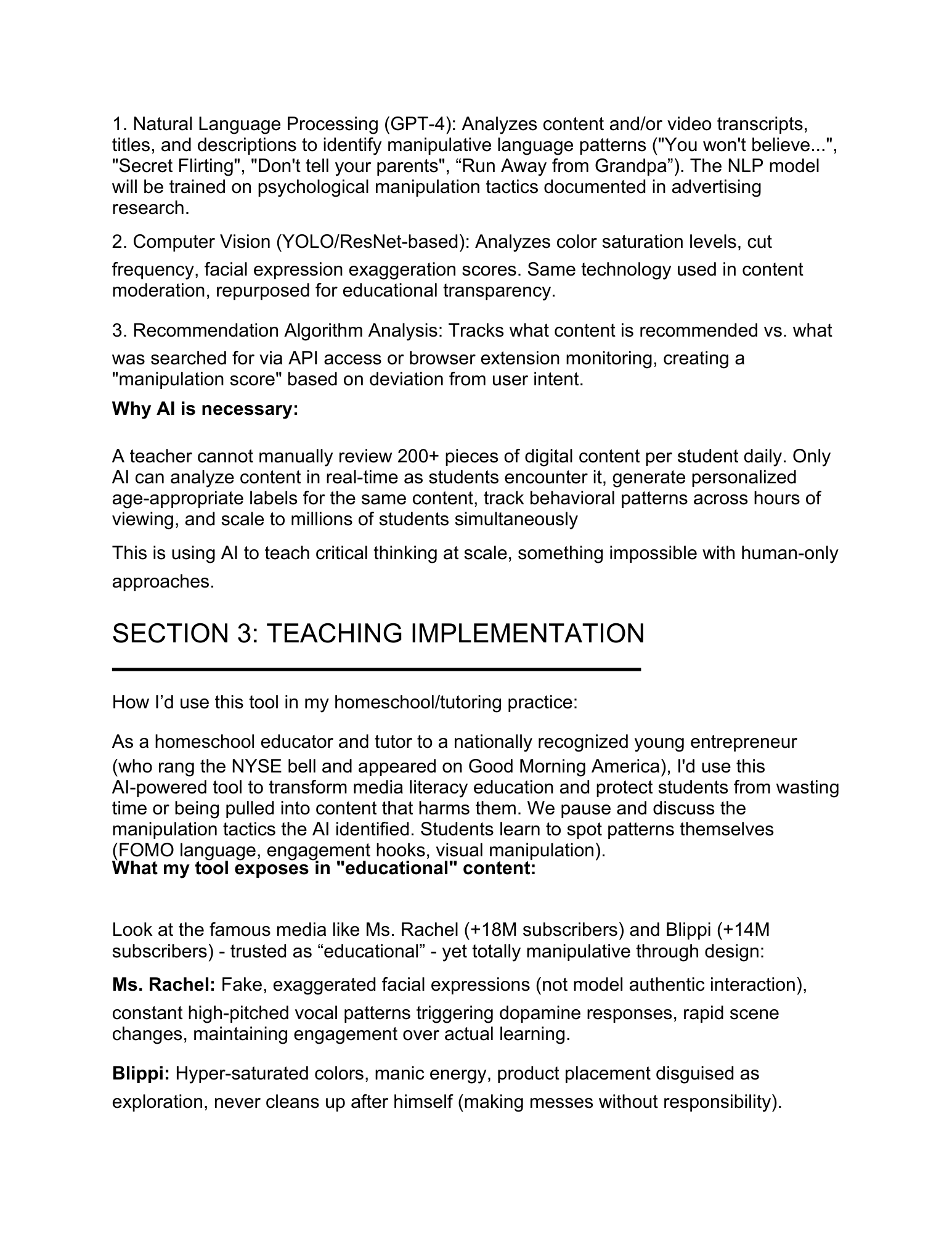
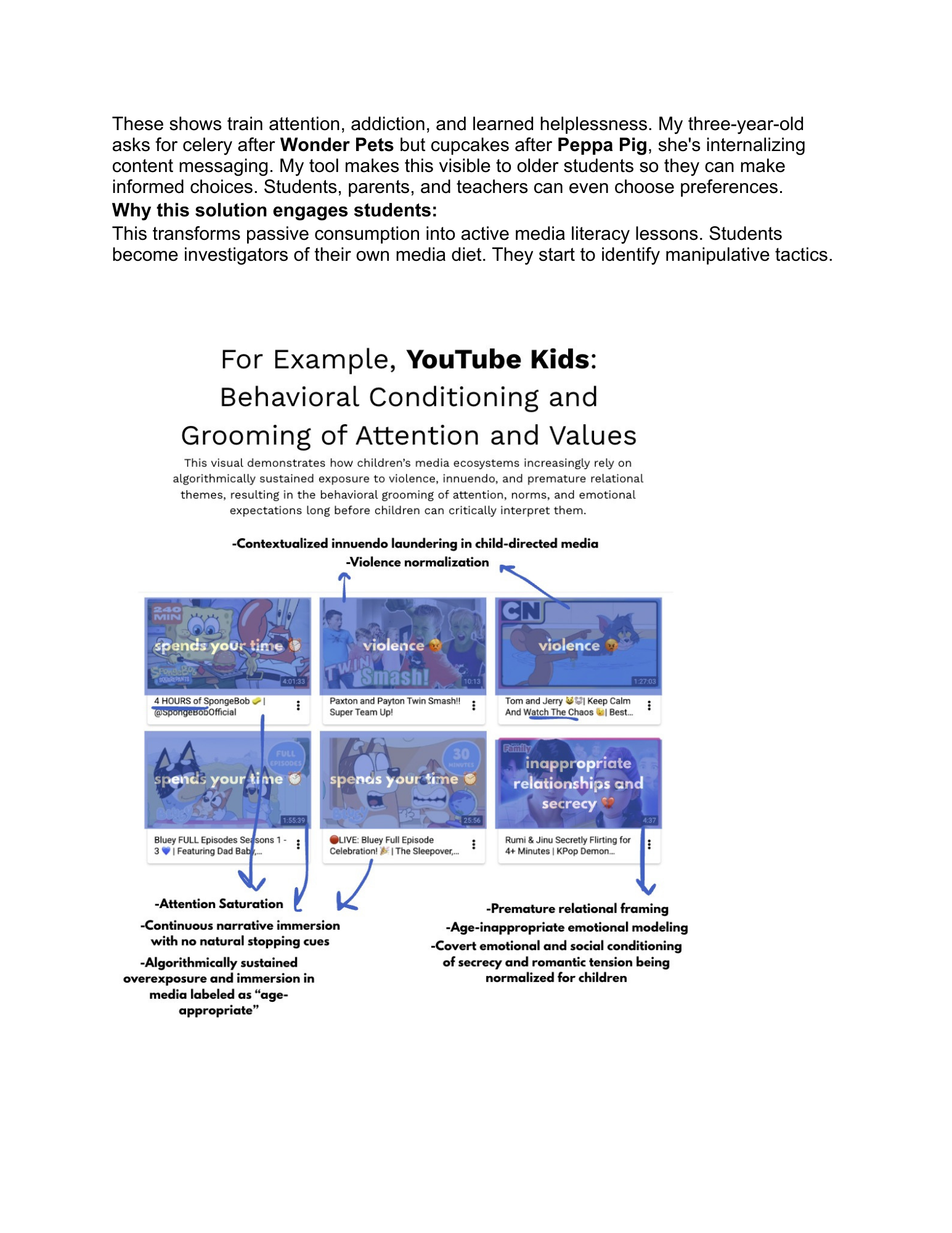
MY FINAL ALMOST-FINAL PROPOSAL (PNG FORM)
—- and do you love that I “cite” my own website/self in my proposal to the White House? hahahah such a flex.
BTW - this PNG form is my OLD version… scroll down to see the FINAL version - 100 times bettterrrrrr (thanks to the notes from that office hour attendance)
My PROPOSAL (written form, for the sake of SEO)
And I made some changes for my final version, but this is the nearly-finished draft :) - the real version is EVEN BETTER :)
Teaching Students to Recognize Digital Manipulation: An AI Tool That Educates Instead of Censors (Educator Track IIIb)
By: Kelly Kirk (Kelly Tutors)
Video Attachment: https://youtu.be/N8gqY_ab0tI
SECTION 1: THE AWARENESS TOOL
Welcome to my proposal, and thanks for reading it, judges! Now let’s get focused: We’re living in the most depressed, screen-obsessed era of human history. And that’s not looking to change anytime soon.
Back in my day, we used to complain about our backs hurting from all the textbooks… well, that’s been “solved” right? With simple, lightweight laptops and screens. But the content playing on these screens… what is it? This “trusted” content to teach students each day. How do we know is it trusted? With labels. Labels like: ‘educational’, ‘child-friendly’, ‘teen-appropriate’, etc. But, actually look behind the curtain (or simply just take the time to watch the content with a critical eye) and we can see that this content is often far from long-term beneficial. Most of the content pushed in our faces is manipulative, influential, and trying to extract our time, attention, money, and sanity. This is especially true for students, since they’re young and malleable. So how do we solve this? How do we teach kids to SEE the manipulation? I propose a content awareness tool powered by AI that teaches K-12 students to recognize digital manipulation in real-time. This system evaluates content and then uses overlaying words and symbols to expose the manipulation. The AI analyzes and generates age-appropriate labels/symbols to break the cycle + teach critical thinking skills and help students realize what’s being shown to them.
Why is this tool so urgently needed:
We're teaching students to consume whatever is in front of them and then regurgitate it back. Right? That’s how school works… we memorize what’s told, think things through, and give appropriate, spelling/grammar-accurate, answers in response. Boom! A+ grade received. Intelligence achieved, right? I’m not sure…
But what happens when the content they’re learning from is not age-appropriate? Or it’s purposefully training them to be addicted to binging, violence, or just random nonsense. As an educator, I’ve watched students complete assignments while simultaneously being trained by algorithms that reward distraction, emotional escalation, and endless scrolling My tool helps bring agency back to students so they can realize what’s being pushed on them. It interrupts this pattern of simply sitting back and consuming by identifying the tricks being played on them in real-time.
SECTION 2: TEACHING IMPLEMENTATION
Students are constantly sent to external platforms to watch videos, complete homework, and learn independently. One of the most popular? Youtube.
In theory, this is a great idea. YouTube is FULL of videos labeled as “educational”... But what happens when they search for keywords and get confusing recommendations, or purposefully distracting videos to watch instead? Students may begin with an educational search, but they are quickly surrounded by recommendations designed to distract, escalate emotion, and extend viewing time. Plus, lots of the “educational” content is just full of product placement and clickbait “brainrot”.
What my tool exposes in "educational" content:
Now more than ever, it is time to empower media literacy education and protect students from wasting their time with harmful/manipulative content. Don’t believe me? Take a look.
Some of the most famous “educational” media for kids, like Ms. Rachel (+18M subscribers) and Blippi (+14M subscribers), are trusted as “educational” - yet totally manipulative through design:
- Ms. Rachel: Fake, exaggerated facial expressions, high-pitched vocals trigger dopamine responses, rapid scene changes, maintaining engagement over learning.
- Blippi: Hyper-saturated colors, manic energy, product placement disguised as exploration, never cleans up after himself (making messes without responsibility).
These shows train attention, addiction, and learned helplessness. Even Mr Beast, with 462M subscribers, is pushed as “family-friendly entertainment” is content designed around spectacle, escalation, and endurance. Not learning.
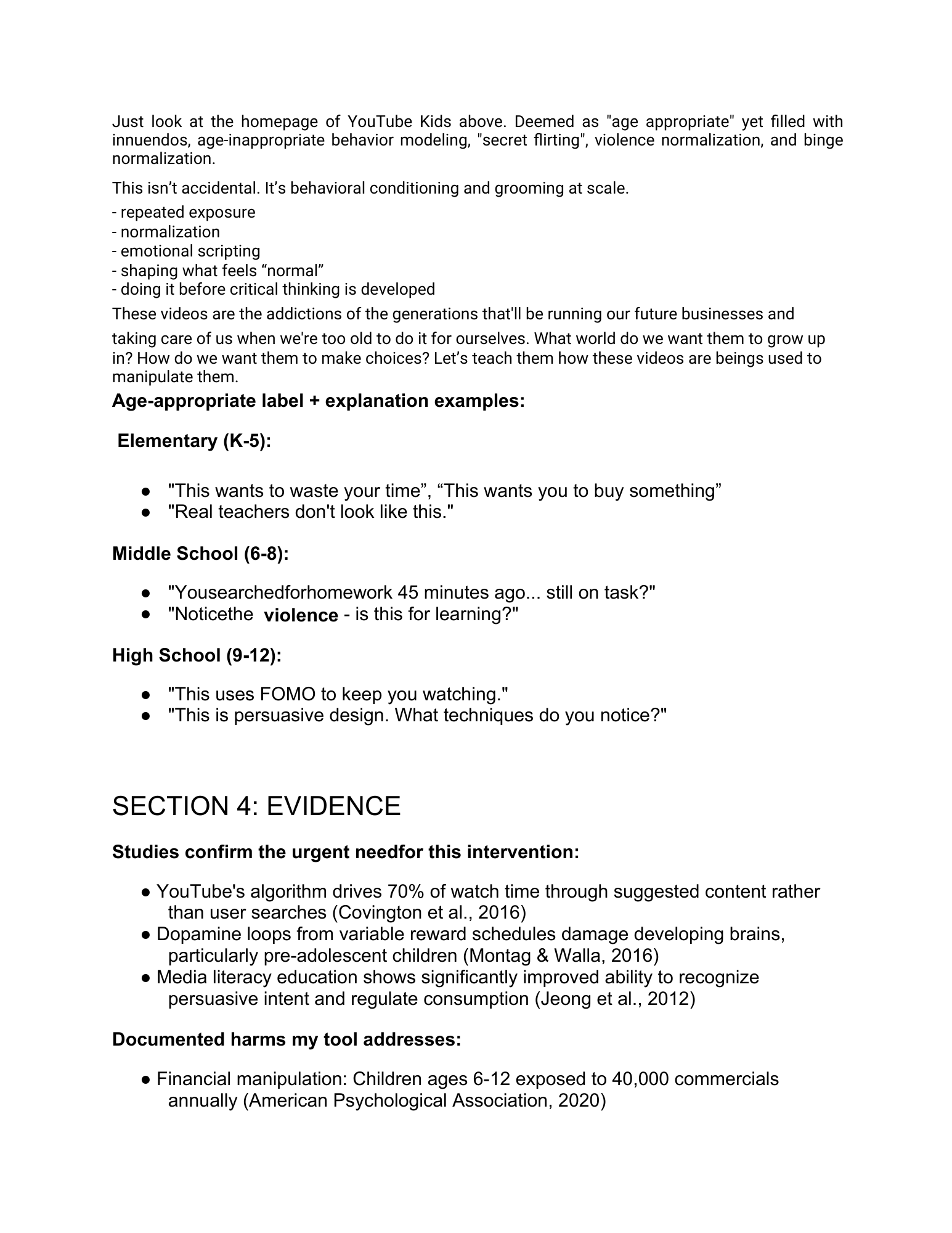
Just look at the homepage of YouTube Kids below (next page). So much of this content is pushed on users and deemed as "age appropriate" yet filled with innuendos, age-inappropriate behavior modeling, "secret flirting", violence normalization, and binge normalization.
This age-inappropriateness isn’t accidental. It’s intentional behavioral conditioning, commercialism, and grooming at scale. Think “grooming” is too dramatic of a word? It’s not! This is textbook grooming…
- repeated exposure
- emotional scripting
- shaping what feels “normal”
- doing it before critical thinking is developed
These videos are the pastimes and addictions of the generations that'll be running our future businesses and taking care of us when we're too old to do it for ourselves. What world do we want them to grow up in? How do we want them to make choices?
Let’s teach them how these videos are being used to manipulate them.
Age-appropriate labels + explanation examples my tool will display:
Elementary (K-5):
"This wants to waste your time”, “This wants you to buy something.”
"Real teachers don't look like this."
Middle School (6-8):
"You searched for homework 45 minutes ago... still on task?"
"Notice the violence - is this for learning?"
High School (9-12):
"This uses FOMO to keep you watching."
"This is persuasive design. What techniques do you notice?"
SECTION 3: AI TECHNOLOGIES:
The tool combines three AI capabilities:
1. Natural Language Processing (GPT-4): Analyzes content and/or video transcripts, titles, and descriptions to identify manipulative language patterns ("You won't believe...", "Secret Flirting", "Don't tell your parents", “Run Away from Grandpa”). The NLP model will be trained on psychological manipulation tactics documented in advertising research.
2. Computer Vision (YOLO/ResNet-based): Analyzes color saturation levels, cut frequency, and facial expression exaggeration scores. Same technology used in content moderation, repurposed for educational transparency.
3. Recommendation Algorithm Analysis: Tracks what content is recommended vs. what was searched for via API access or browser extension monitoring, creating a "manipulation score" based on deviation from user intent.
Why is help from AI necessary?
A teacher cannot manually review 200+ pieces of digital content per student daily. Only AI can analyze content in real-time as students encounter it, generate personalized age-appropriate labels for the same content, track behavioral patterns across hours of viewing, and scale to millions of students simultaneously
This is using AI to teach critical thinking at scale, something impossible with human-only approaches.
SECTION 4: EVIDENCE
Studies completely confirm the urgent need for this intervention:
YouTube's algorithm drives 70% of watch time through suggested content rather than user searches (Covington et al., 2016)
Dopamine loops from variable reward schedules damage developing brains, particularly pre-adolescent children (Montag & Walla, 2016)
Media literacy education shows significantly improved ability to recognize persuasive intent and regulate consumption (Jeong et al., 2012)
Documented harms that my tool helps to address:
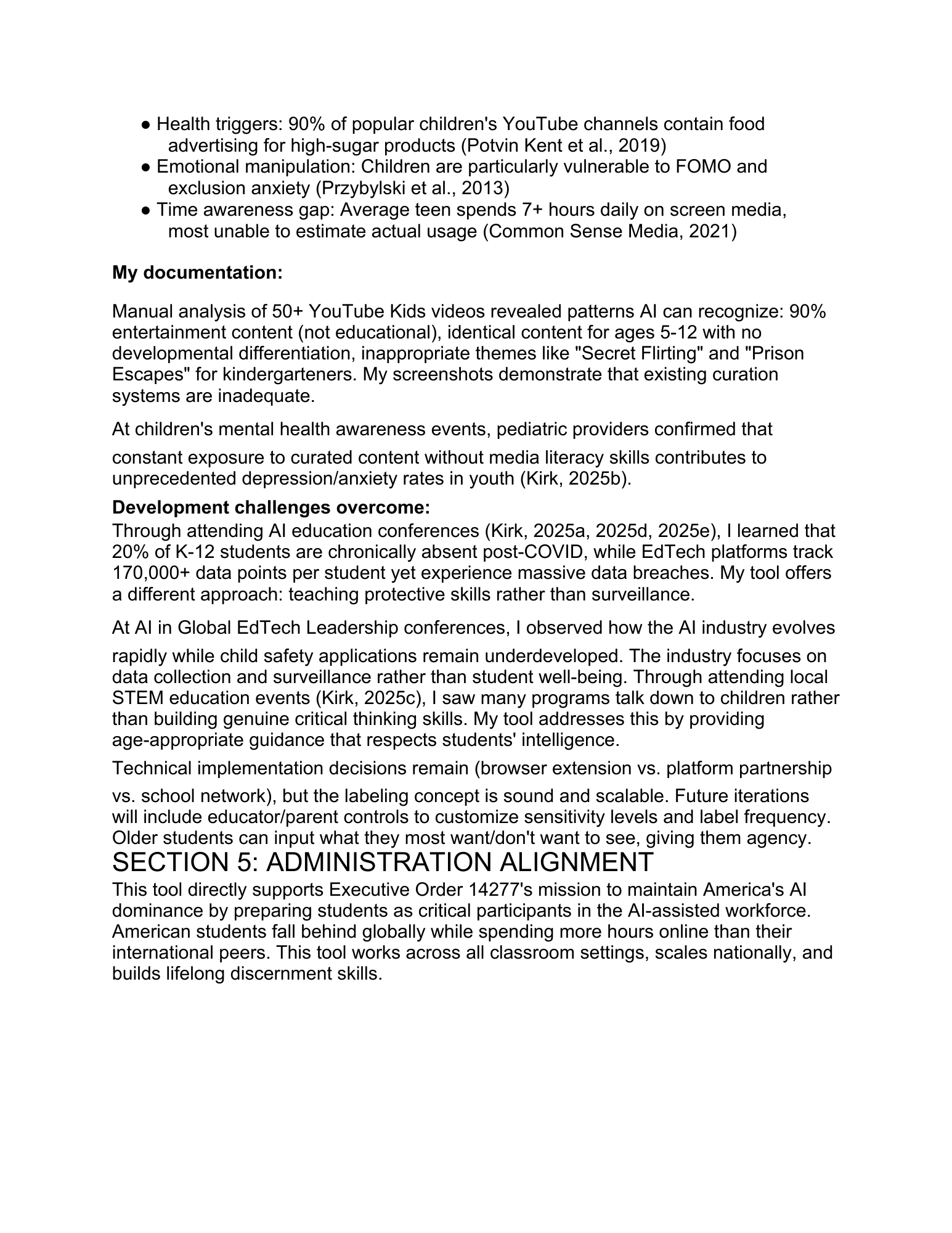
Financial manipulation: Children ages 6-12 are exposed to 40,000 commercials annually (American Psychological Association, 2020)
Health triggers: Yikes!! 90% of popular children's YouTube channels contain food advertising for high-sugar products (Potvin Kent et al., 2019)
Emotional manipulation: Children are particularly vulnerable to FOMO and exclusion anxiety (Przybylski et al., 2013)
Time awareness gap: The average teen spends 7+ hours daily on screen media, most unable to estimate actual usage (Common Sense Media, 2021)
My documentation:
I analyzed over 50+ YouTube Kids videos to reveal patterns AI can recognize: 90% entertainment content (not educational), identical content for ages 5-12 with no developmental differentiation, inappropriate themes like "Secret Flirting" and "Prison Escapes" for kindergarteners.
As a mission-driven education professional, I’ve attended children's mental health awareness events, where pediatric providers confirmed that this constant exposure without media literacy skills contributes to unprecedented depression/anxiety rates in youth (Kirk, 2025b). And through attending numerous AI education conferences to help with my research on this project (Kirk, 2025a, 2025d, 2025e), I learned that over 20% of K-12 students are chronically absent post-COVID, while EdTech platforms track 170,000+ data points per student, yet experience massive data breaches. My tool offers a different approach: teaching protective skills rather than surveillance.
At AI in Global EdTech Leadership conferences, I’ve also observed how the AI industry is evolving at record speeds… all while actual ‘student mental safety’ remains underdeveloped and ignored. Instead, they’re products for the corporate machine, to be manipulated and extracted from. This industry focuses on data collection over student well-being. Through attending local STEM education events (Kirk, 2025c), I saw many programs talk down to children rather than building genuine critical thinking skills. My tool addresses this by providing age-appropriate guidance that respects students' intelligence. They have so much to teach us and can help us solve problems when we actually give them a chance.
Development challenges to overcome:
Well, my graphics/design isn’t especially beautiful/attractive, but I invite a team to help me build it out. Also, technical implementation decisions remain (browser extension vs. platform partnership vs. school network), but the labeling concept is sound and scalable. Future iterations can include educator/parent controls to customize sensitivity levels and label frequency. Plus, older students can input what they most want/don't want to see, giving them agency.
SECTION 5: ADMINISTRATION ALIGNMENT
This tool directly supports Executive Order 14277's mission to maintain America's AI dominance by empowering students to be critical participants in the AI-assisted workforce.
American students fall behind globally… while spending more hours online than their international peers! This tool helps work across all classroom settings, scales nationally, and builds lifelong discernment skills.
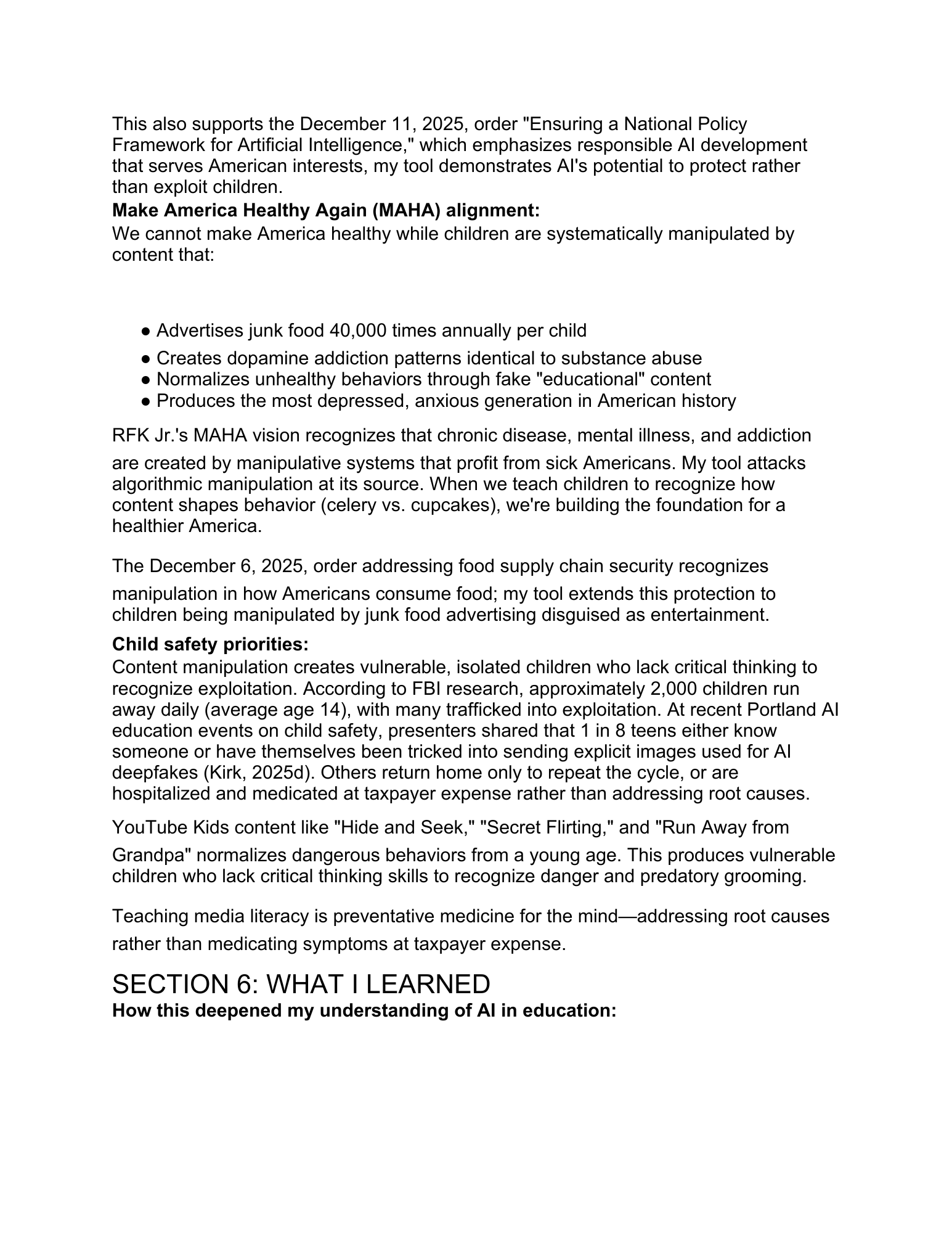
This also supports the December 11, 2025, order "Ensuring a National Policy Framework for Artificial Intelligence," which emphasizes responsible AI development that serves American interests, my tool demonstrates AI's potential to protect rather than exploit children.
Make America Healthy Again (MAHA) alignment:
We cannot make America healthy while children are systematically manipulated by content that:
Advertises junk food 40,000 times annually per child
Creates dopamine addiction patterns identical to substance abuse
Normalizes unhealthy behaviors through fake "educational" content
Produces the most depressed, anxious generation in American history
RFK Jr.'s MAHA vision recognizes that chronic disease, mental illness, and addiction are created by manipulative systems that profit from sick Americans. My tool attacks algorithmic manipulation at its source. When we teach children to recognize how content shapes behavior (celery vs. cupcakes), we're building the foundation for a healthier America.
The December 6, 2025, order addressing food supply chain security recognizes manipulation in how Americans consume food; my tool extends this protection to children being manipulated by junk food advertising disguised as entertainment.
Child safety priorities:
YouTube Kids content like "Hide and Seek," "Secret Flirting," and "Run Away from Grandpa" normalizes dangerous behaviors from a young age. This produces vulnerable children who lack critical thinking skills to recognize danger, coercive influence, and predatory grooming.
Content manipulation creates vulnerable, isolated children who lack critical thinking to recognize exploitation. According to FBI research, approximately 2,000 children run away daily (average age 14), with many trafficked into exploitation. At recent Portland AI education events on child safety, presenters shared that 1 in 8 teens either know someone or have themselves been tricked into sending explicit images used for AI deepfakes (Kirk, 2025d). Others return home only to repeat the cycle, or are hospitalized and medicated at taxpayer expense rather than addressing root causes.
Teaching media literacy is preventative medicine for the mind, addressing root causes rather than medicating symptoms at taxpayer expense.
SECTION 6: WHAT I LEARNED
How this deepened my understanding of AI in education:
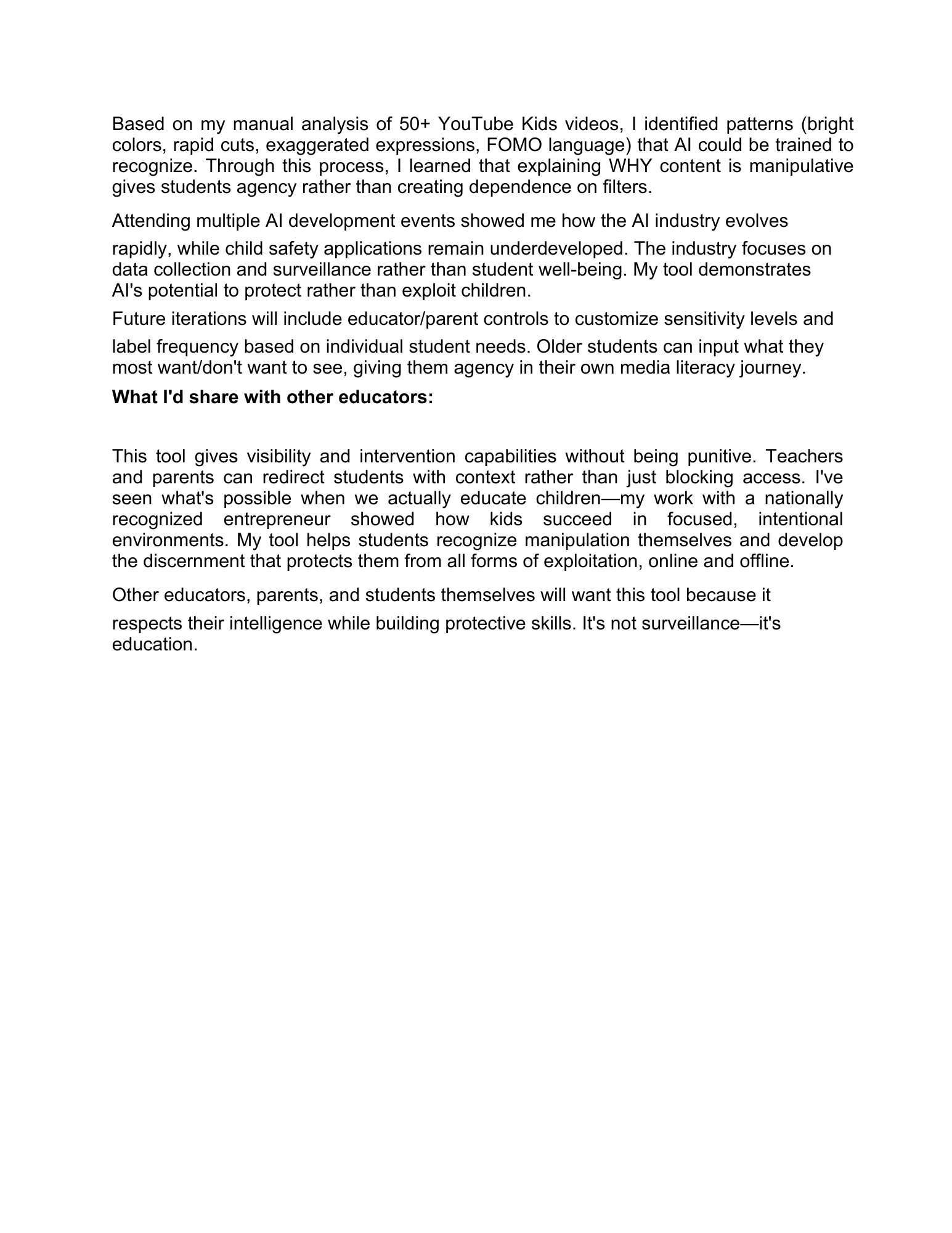
Through this process, I learned that explaining WHY content is manipulative gives students agency rather than creating dependence on filters. At first, I wanted to make more of a “pop-up blocker” (which was even well-received in the official White House Office Hours for this event)... but the more I thought about it, simply “blocking content” makes the pendulum only swing harder when students are finally exposed to the hidden content. Instead, teaching them to understand “why” this content is manipulative to them, equipts then with life-long skills and tools for success.
What I'd share with other educators:
Teachers and parents can redirect students with context rather than just blocking access. I've seen what's possible when we actually educate children and my work with a nationally recognized kids-entrepreneur shows how well kids can succeed in focused, empowering, and intentional environments. My tool helps students recognize manipulation themselves and develop the discernment that protects them from all forms of exploitation, online and offline.
Other educators, parents, and students themselves will want this tool because it respects their intelligence and educates them.
Let’s stop the controlling manipulation and bring power back to the people.
Thank you for your time. :)
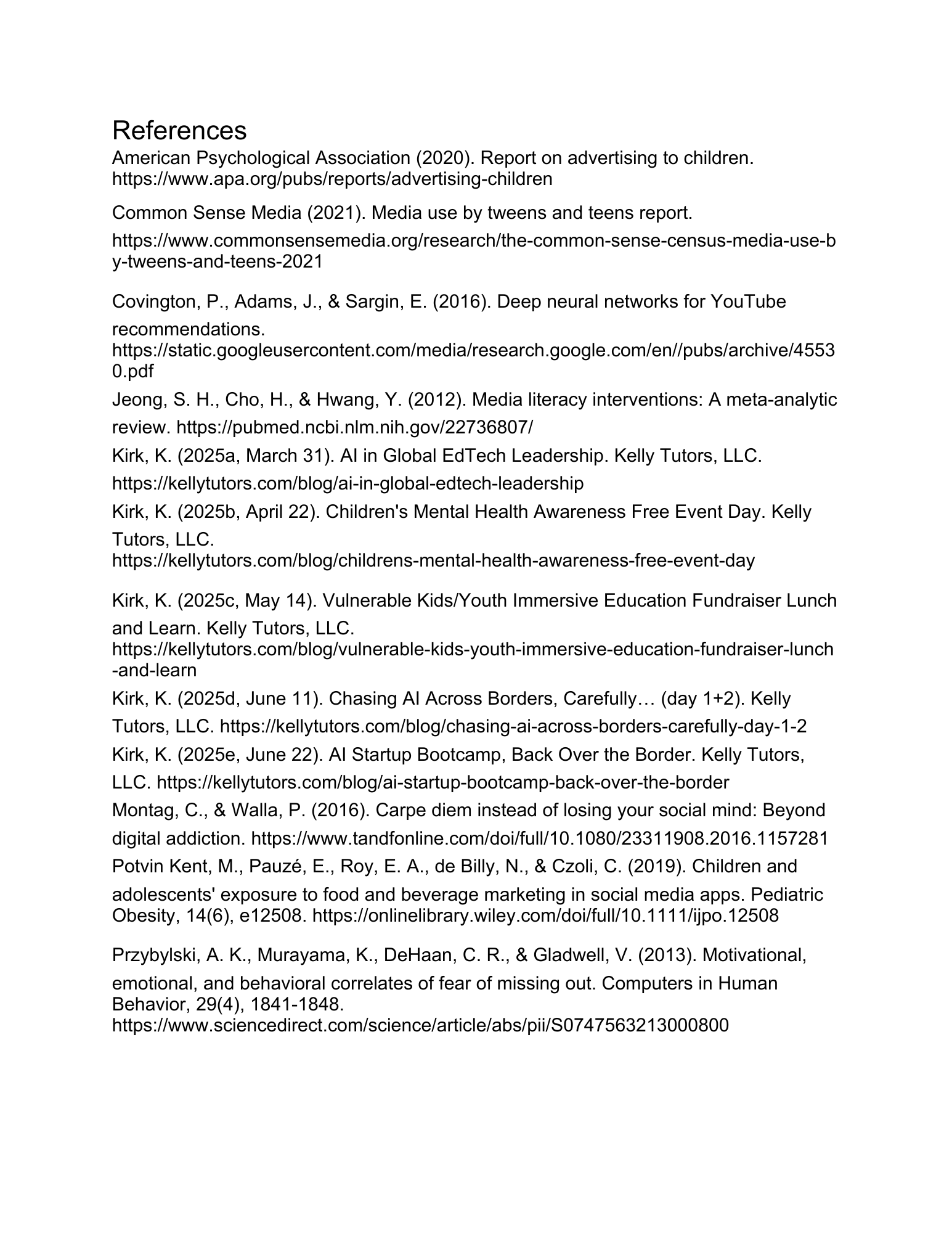
References
American Psychological Association (2020). Report on advertising to children. https://www.apa.org/pubs/reports/advertising-children
Common Sense Media (2021). Media use by tweens and teens report. https://www.commonsensemedia.org/research/the-common-sense-census-media-use-by-tweens-and-teens-2021
Covington, P., Adams, J., & Sargin, E. (2016). Deep neural networks for YouTube recommendations. https://static.googleusercontent.com/media/research.google.com/en//pubs/archive/45530.pdf
Jeong, S. H., Cho, H., & Hwang, Y. (2012). Media literacy interventions: A meta-analytic review. https://pubmed.ncbi.nlm.nih.gov/22736807/
Kirk, K. (2025a, March 31). AI in Global EdTech Leadership. Kelly Tutors, LLC. https://kellytutors.com/blog/ai-in-global-edtech-leadership
Kirk, K. (2025b, April 22). Children's Mental Health Awareness Free Event Day. Kelly Tutors, LLC. https://kellytutors.com/blog/childrens-mental-health-awareness-free-event-day
Kirk, K. (2025c, May 14). Vulnerable Kids/Youth Immersive Education Fundraiser Lunch and Learn. Kelly Tutors, LLC. https://kellytutors.com/blog/vulnerable-kids-youth-immersive-education-fundraiser-lunch-and-learn
Kirk, K. (2025d, June 11). Chasing AI Across Borders, Carefully… (day 1+2). Kelly Tutors, LLC. https://kellytutors.com/blog/chasing-ai-across-borders-carefully-day-1-2
Kirk, K. (2025e, June 22). AI Startup Bootcamp, Back Over the Border. Kelly Tutors, LLC. https://kellytutors.com/blog/ai-startup-bootcamp-back-over-the-border
Montag, C., & Walla, P. (2016). Carpe diem instead of losing your social mind: Beyond digital addiction. https://www.tandfonline.com/doi/full/10.1080/23311908.2016.1157281
Potvin Kent, M., Pauzé, E., Roy, E. A., de Billy, N., & Czoli, C. (2019). Children and adolescents' exposure to food and beverage marketing in social media apps. Pediatric Obesity, 14(6), e12508. https://onlinelibrary.wiley.com/doi/full/10.1111/ijpo.12508
Przybylski, A. K., Murayama, K., DeHaan, C. R., & Gladwell, V. (2013). Motivational, emotional, and behavioral correlates of fear of missing out. Computers in Human Behavior, 29(4), 1841-1848. https://www.sciencedirect.com/science/article/abs/pii/S0747563213000800
Until next time, I wish you the motivation and success to search for opportunities around your area. Search and explore: Who is out there giving talks? There are new things happening all of the time.
Find relatable or interesting topics you like and check them out! Maybe even something hosted at a cool venue, if there’s no other reason to go. Let’s see what you can learn and discover not too far from home. 😊
