
How I’m using a preliminary story audit to make more intentional creative choices at Kelly Tutors.
1. Choose the moments and show your choices
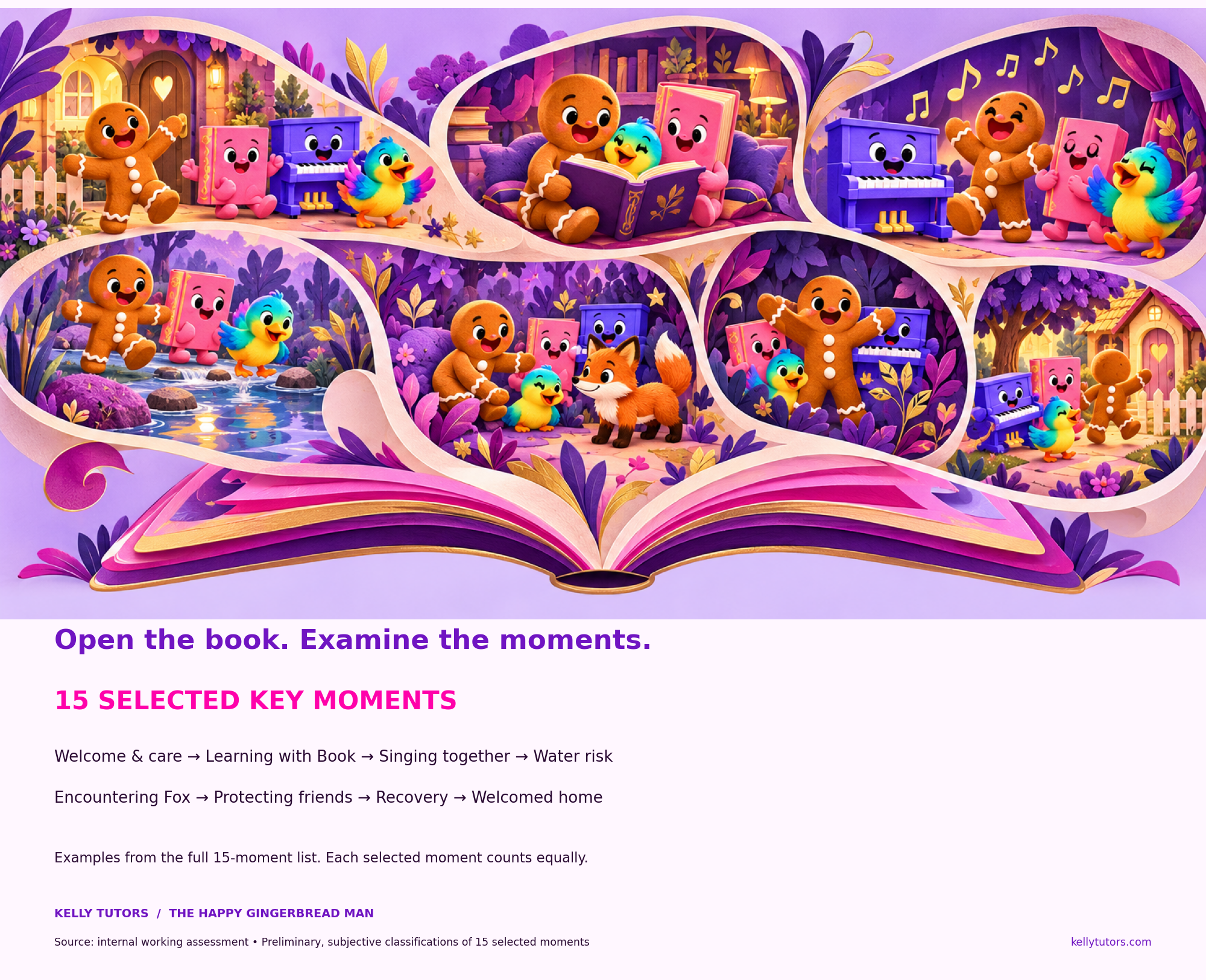
A percentage begins long before anyone makes a chart. Someone decides what to count.
In my working assessment of The Happy Gingerbread Man, the unit is a selected key moment: a meaningful beat in the narrative. The current breakdown contains 15 such moments, including setting out, learning with Book, encountering Fox, protecting friends, and being welcomed home.
These moments give me a manageable way to examine the story’s structure. They also involve judgment. Another reader might divide the same pages differently or select a different set of events.
That is why I want to keep the moment list visible. A reader should be able to ask why one event was included, where another was left out, and whether a long sequence has been given the same weight as a brief exchange.
The first design decision in an audit is the sample itself.
2. Put the counts beside the percentages
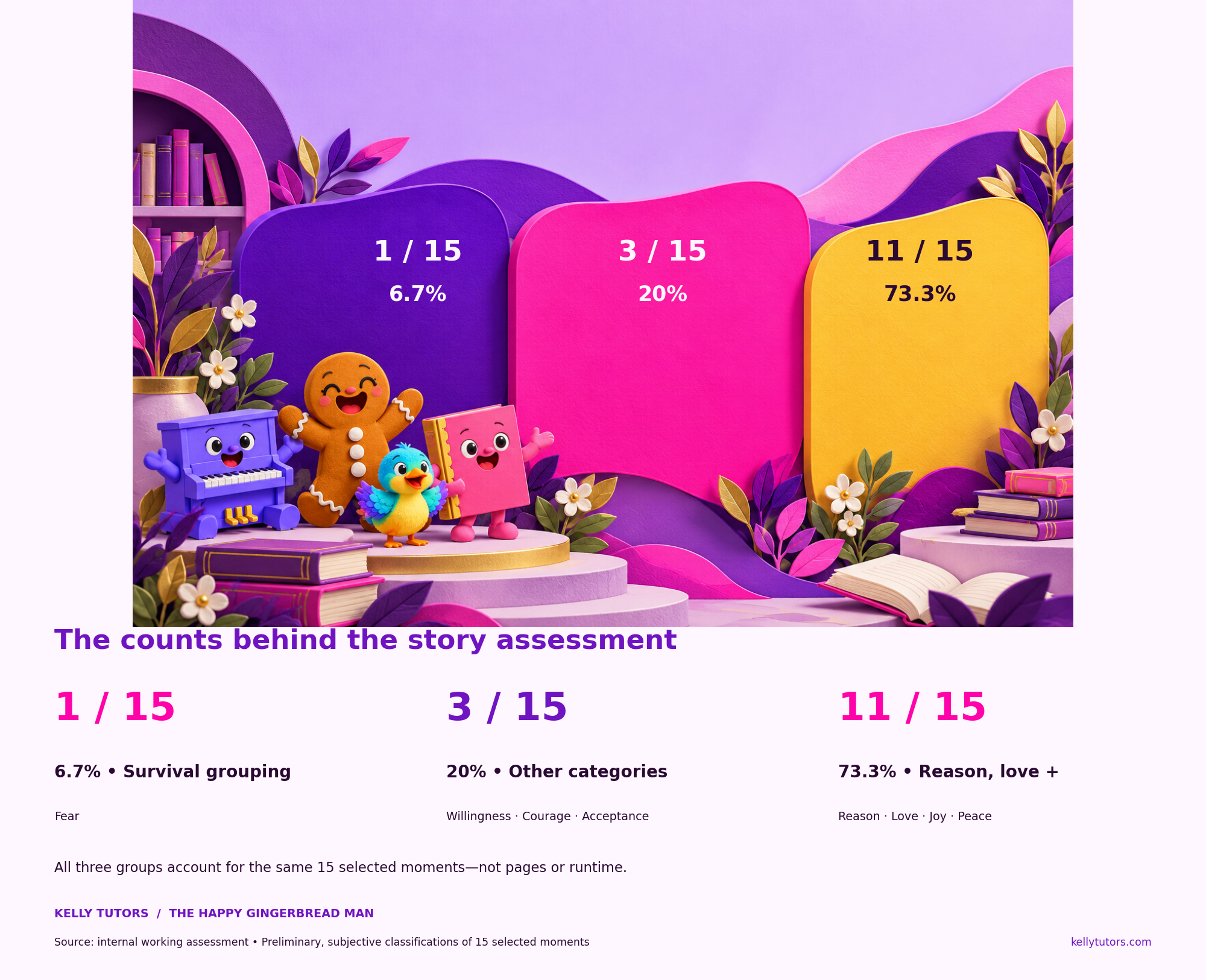
My working materials describe approximately 6% of selected moments in a survival/trauma grouping and approximately 73% in reason, love, and related categories.
Recounting the 15 listed moments makes the arithmetic clearer:
1 of 15: 6.7% in the survival grouping, represented by the Fox encounter assigned to fear.
3 of 15: 20% in willingness, courage, and acceptance.
11 of 15: 73.3% in reason, love, joy, and peace.
Together, those groups account for all 15 selected moments. Each moment receives equal weight in this particular calculation.
That last detail matters. These figures describe the distribution of my selected narrative beats. They are not percentages of pages or runtime. A short exchange and a longer sequence can each count as one moment.
Showing both the numerator and denominator makes the result easier to examine—and makes it clearer what would change if the moment list changed.
3. Look inside the label
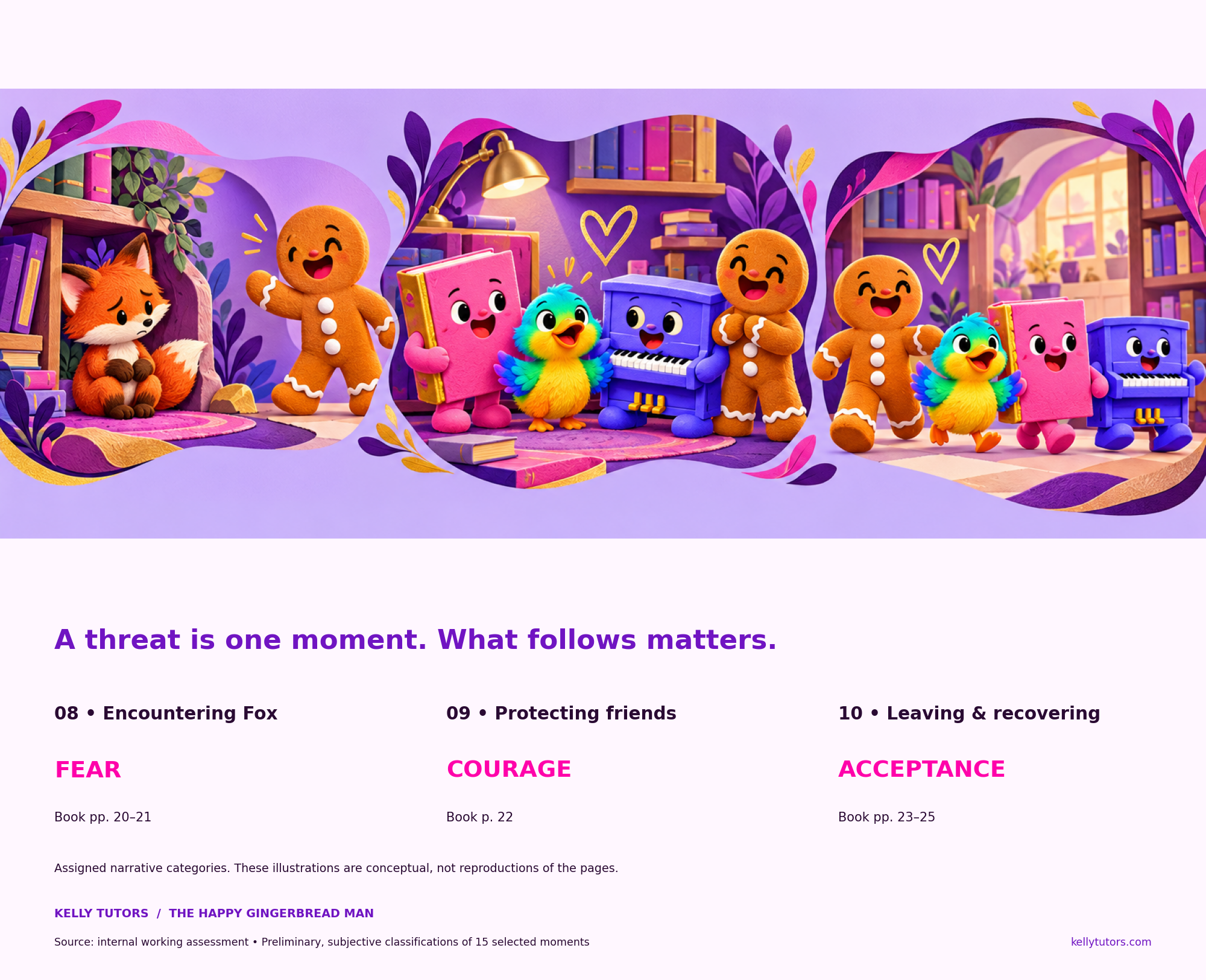
The most useful part of the audit is often the conversation underneath a category.
In the current assessment, three consecutive moments receive different assignments: encountering Fox is coded as fear; protecting friends as courage; and leaving and recovering as acceptance.
That sequence directs my attention to what the characters do after a threat appears. Who responds? What choices become available? Does the story offer a way to leave, seek support, or reconnect?
Other assignments deserve scrutiny, too. A water-risk moment is classified as reason in the working breakdown. That prompts a methodological question: am I coding the presence of danger, the character’s response to it, or the dominant meaning of the whole scene?
A transparent guide needs to answer that consistently. Otherwise, the same event could receive different labels depending on which feature a reviewer notices first.
These are subjective interpretations using Hawkins-inspired vocabulary as a creative and philosophical lens. A label such as “fear” describes my reading of a narrative moment; it does not diagnose a reader or measure their emotional state.
4. Make the method easier to challenge
My working materials also examine selected moments in family films. For stronger comparisons, the same process needs to apply across every title.
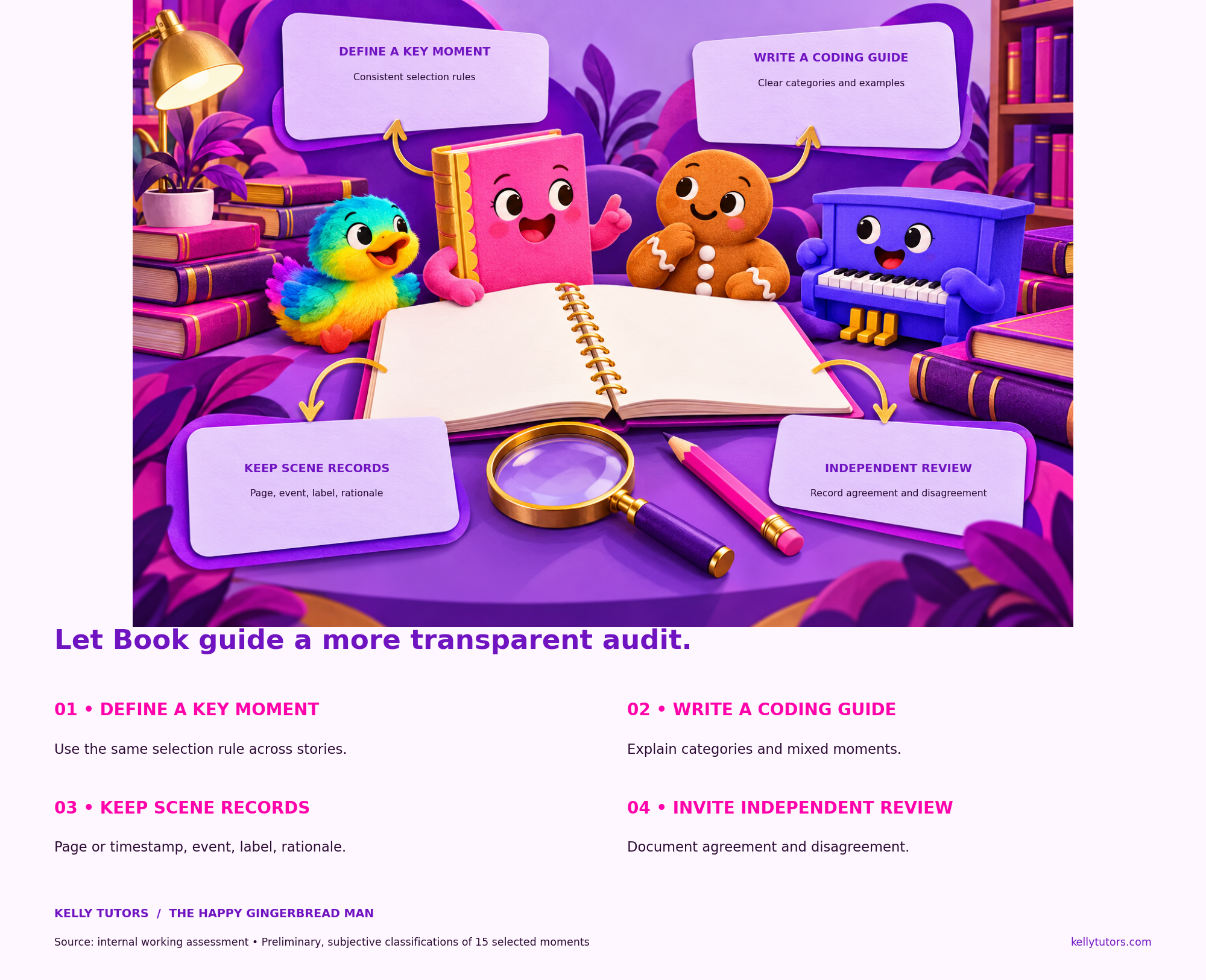
I would strengthen the method in four practical ways:
Define a key moment. Establish how events are selected and where one moment ends and another begins.
Write a coding guide. Explain each category, give examples, and specify how mixed or ambiguous moments are handled.
Keep scene-level records. Record the page or timestamp, what happens, the assigned category, and the reason for that assignment.
Invite independent reviewers. Have other people code the same material, then document agreement, disagreement, and any revisions.
Those steps make a comparison more reviewable. They do not turn a philosophical framework into a validated developmental measure. They do help reveal whether the conclusions depend on choices that other people would make differently.
Disagreement can be useful information. It may expose an unclear definition, a mixed scene, or a question the original assessment overlooked.
5. Use the audit to change the draft
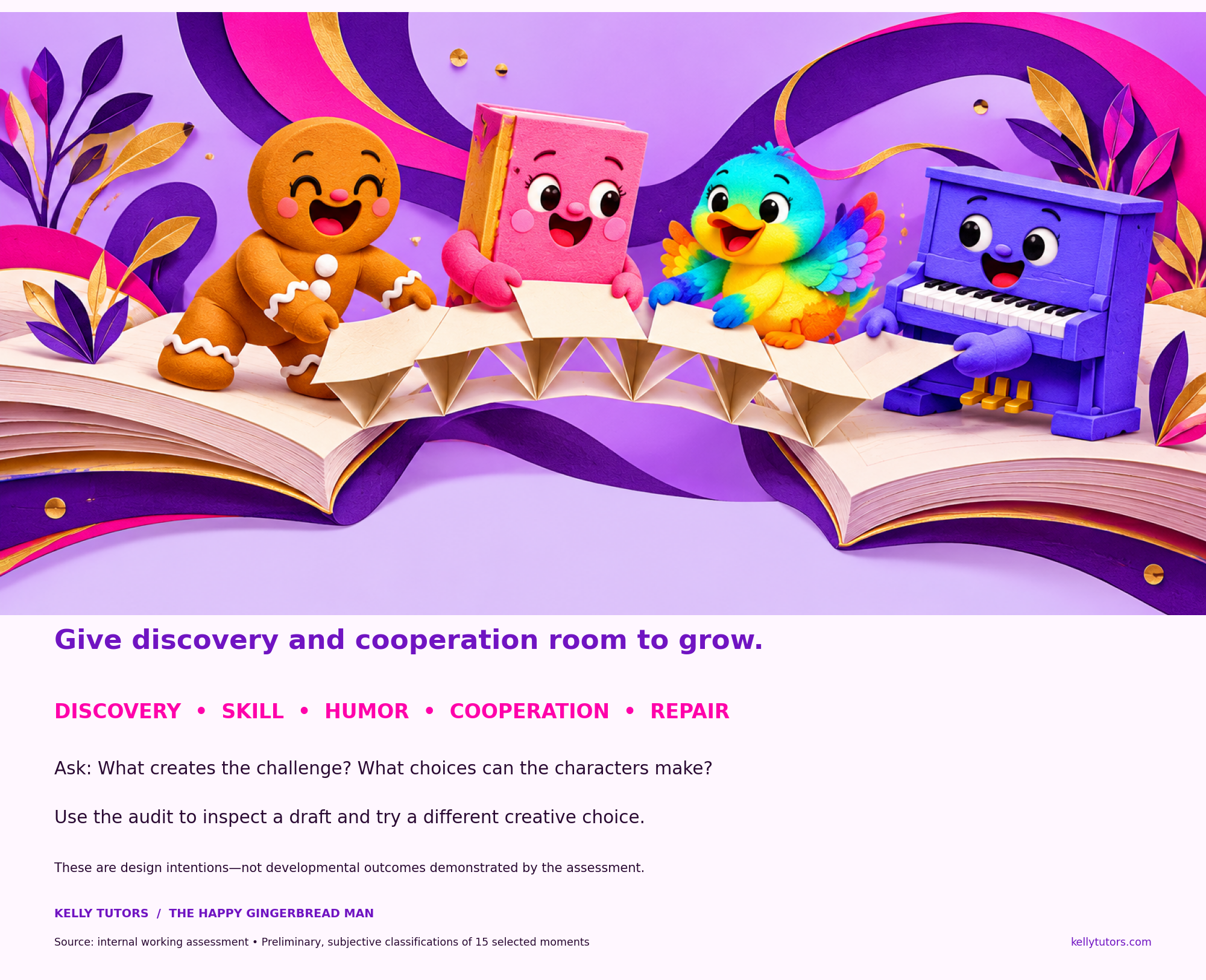
The purpose of this work is to help me write with greater intention.
If my selected moments repeatedly involve pursuit, abandonment, coercion, or helplessness, I can examine what is carrying the plot. Could discovery generate the next turn? Could learning a skill create the challenge? Could humor, cooperation, or taking responsibility make the scene more interesting?
For The Happy Gingerbread Man, I want friendship, thoughtful action, boundaries, and belonging to have substantial space in the narrative. The audit helps me examine whether those intentions appear in the moments I have actually written.
It does not establish that the book produces a particular developmental outcome. That would require a different kind of investigation involving readers.
What it gives me now is a practical revision tool: a way to notice a pattern, inspect the choices underneath it, and try another version.
A colorful percentage should invite examination. The creative work happens when we open it up.
Explore the stories at Kelly Tutors.
Fund the Rescued Fairy Tales.
Source: Kelly Tutors’ internal working assessment in HOLY BINDER(1), with the 15-moment breakdown transcribed from its story graph. The graphics show preliminary interpretations of selected story moments, not measured effects on children. “Other categories” here means willingness, courage, and acceptance.
