
Advocating for Homeless Youth (and Families)
Disclaimer: Everything below is a mix of what I observed and heard during the event. The goal isn’t to pinpoint "who exactly said what," but to share (usually) an outsider's view and overall perspective on these industries. I’m not here to act as a definitive firsthand source—readers should do their own research. I hope this inspires you to attend events, explore new industries, and hear what leaders are presenting. These notes combine my observations with thoughts on how things could run smoother and how ideas connect (IMO). I’m not an expert, you know? Just hanging out in the room with them. Enjoy.
HelloOo!!! I’m jumping on a webinar, and it’s morning. I actually had a very amazing talk this morning with a friend who is enjoying all of my blogs - which is a sentence I’ve never been able to say before. It’s really nice. Someone who thinks similarly to me, sees patterns as I do… so many things. So, my mood and the weight of the world feel lighter thanks to this new friendship. I’m very grateful. Now - let’s talk about this event I’m about to join.
Why Attend: I’m super dedicated to learning about how to help kids and creating content to reduce stress, prevent trauma, relate to kids, give them the love they deserve… so many things. I feel like homeless kids are absolutely dear and vulnerable to so much… one of the most sad situations - ONE, not the absolute, things can be worse of course. But the more people speak up, face difficult things, and learn, we can be educated and help.
Photo Collage + Commentary
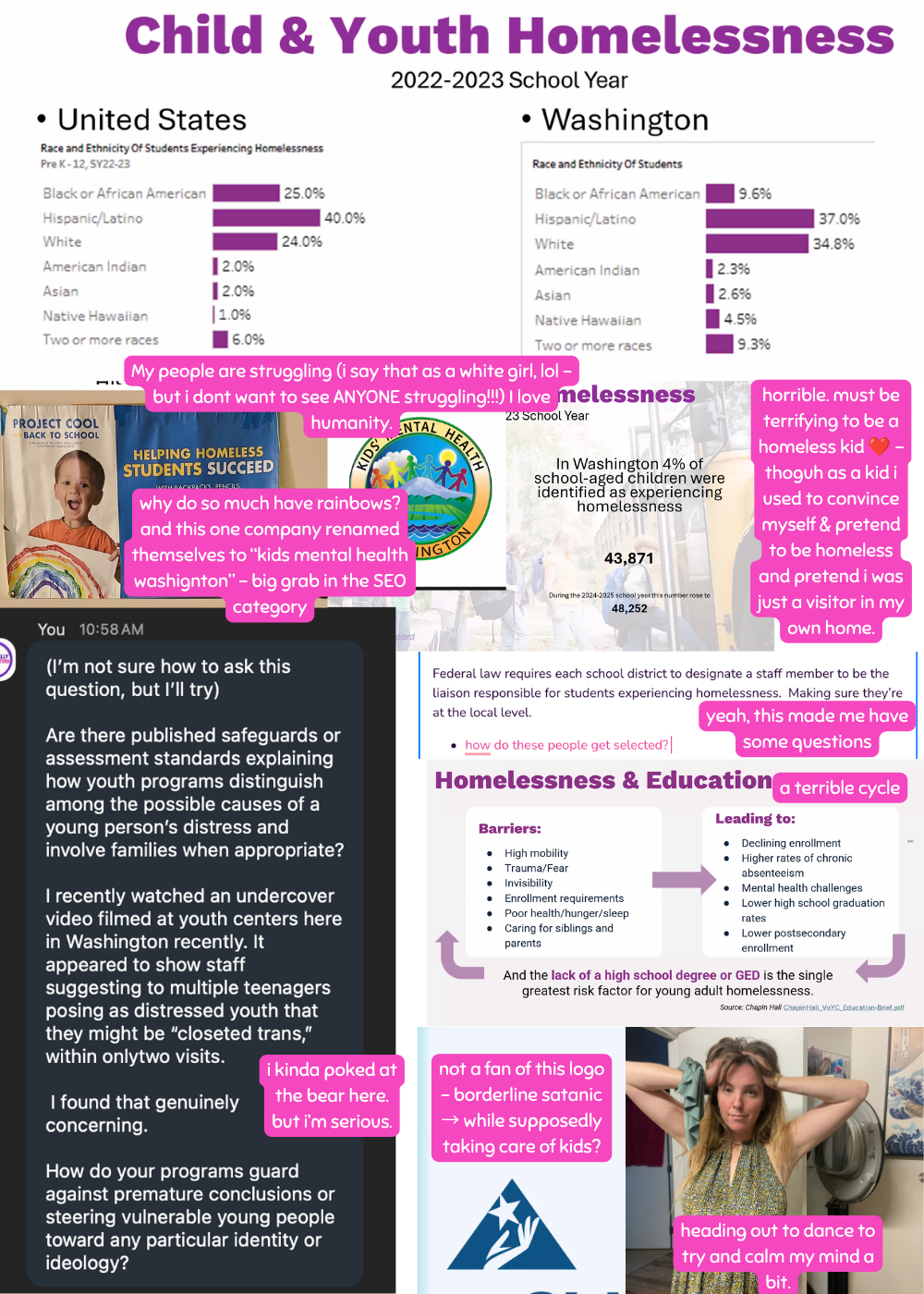
Notes from the Event:
Arrival.
They ask everyone to introduce themselves in the chat. I do. I notice lots of people talk. From school districts, daycares, “solid ground”, the public library, re-housing, a man who works for a woman’s shelter downtown (which is COVERED in butterflies all around the outside of it), therapists, youth havens, housing, hotlines, immigration rights, all sorts of things.
They said you’re not allowed to do AI recording in this event.
They challenge systemic causes of homelessness and envision a region that acts on a shared sense of responsibility. Live out equity, justice, and collective aciton. Their coalition is made up of agencies that provide housing, shelter, human services, healthcare, and allied organizations and individuals. They have meetings every thursday from 9-10:30 online.
They help people apply for TANF, SSI, Medicare, Medicaid, and SNAP.
They advocate for good policies and budgets at the city, county, state, and national level.
Recent vicious cuts to food stamps were made. We advocate because that’s how together, we can see real solutions for homelessness, housing injustice, and housing instability.
We recognize how much more strength and power we’ve got when we act together.
They go through the agenda… but now I wanna go make myself a coffee and tea, and then get back into this.
Yeah i’m just making myself breakfast and tea + coffee… and they just introduce htier companies and how (expectedly) they’re working to support homeless kids.
They said of course, we’ll talk about McKinney-Vento (hahah idk what this is) but they act like everyone knows.
Nationally, 3% of the USA kids are homeless, 4% in Washington state. 2024-2025: 5,000 more kids than usual.
Where do they stay? With others temporarily. Shelters, hotels….
They’re changing locations all of hte time. Couchsurfing, a shelter, constant instability.
A lack of adequate resources, safety… sometimes the barriers are too high (maybe no pets)
They’re very vulnerable to sexual exploitation and harm.
Kids experience trauma/fear, invisibility, caring for others, poor health, hunger, poor sleep.
This leads to declining enrollment, chronic absenteeism, mental health issues, and lower graduation rates. Dropping out of school.
Definition of Homeless: children and youth who lack a fixed, regular, adequate nighttime residence.
Not sharing housing, living in motels, hotels, trailer parks, camping grounds, abandoned in hospitals, shelters, public or private places not usually sleeping accommodations, bus stations, train stations, abandoned cars.
And migratory children living in these situations
Young children in a temporary place
Unaccompanied Youth: not in the custody of a parent or guardian. Experiencing homelessness.
Students’ Core Rights provided under the McKinney-Vento Act:
Receive a free, appropriate public education
enroll in school immediately, even if lacking documents normally required for enrollment
enroll in school and attend classes while school gathers needed documents
continue attending the school of origin or enroll in the local attendance area school
receive transportation to and from the school of origin
have access to and receive educational services for which they are eligible
receive educational services comparable to those provided to other students, according to each student’s need
removal of barriers ato accessing academic and extracurricular activities
Just… as someone who thinks school is a bit of a joke (not that there’s much else better in its place) - i’m not surprised they want to keep kids in school… but, i jsut with school was better. Taught better skills.
Federal law requires each school district to designate a staff member to be the liaison responsible for students experiencing homelessness. Making sure they’re at the local level.
how do these people get selected?
identification, enrollment, identification of referral programs, community referrals, full participation, outreach and awareness, policies, dispute
The liaison is a coordinator
omg by mistake my ai note taker was on, but then i had to turn it off and they told me to turn it off
Okay, the liaison has to identify more than 10 unaccomplished youth and focus on middle school and high school students. But now every k-12 has a building point of contact to make sure someone at the school can recognize when a student may need support.
Each liaison will help keep the student in the school of origin for the duration of homelessness or til the end of the academic year, which studnet becomes permanently housed.
When we’re talking about keeping a young person in their school of origin, that’s where transportation becomes very important. When it comes to transportation, a barrier can be to participating fully in school - extracurriculars.
The Uber may pick me up from the shelter at 6pm and pick me up from school at 3pm. But if they communicate when they know they have extracurriculars, they can arrange to have their driver pick them up later. it’s important to know that transportation can be a barrier but easily resolved with proper communication.
Geez, this is just like really… idk the word. IT’s just like they’re going through “student rights” and clarifying what it means to have “the right to enroll in school immediately” - okay. hahah.
School liaison collects attendance
What we do on the k-12 level of unaccompanied youth plays out when they enter college. This impacts getting financial aid. Getting the McKinney-Vento verification can be useful later on.
The Office of Homeless Youth image looks spooky. Their image. I wanna call them out on it.
This event is so technical. Talking about dispute resolution processes, all sorts of things.
Next, we’re moving into hypotheticals and then a Q&A after.
Here’s a typical scenario that we see:
A 17-year-old student who is in a juvenile detention center. He is eligible to be released from the detention center while waiting for trial, but he doesn’t have housing to release to. He’s been couch surfing with friends and attending school at the detention center. He wants a secure bed and felt supported by his old school. He wants to finish out the school year there.
I questioned why changing schools is so frowned upon. Why not just go to a closer school, get a fresh start… especially if they were up to trouble while at their old school?
I don’t get it.
One lady jumps in, the liaison in public schools nearby, and she says in a situation like the one above, looking at what’s in the best interest of the child (this woman sounds sweet) - is the key. First, look at if the student qualifies for the services.
This example child is a homeless and unaccompanied youth.
Highline would probably already have this child identified in their system
Likely not switch schools AGAIN.
Even if they were getting into trouble at the old school, they still have the right to return.
I think this is so disruptive for everyone else- over and over again putting up with troublesome kids. It distracts everyone else and takes up the entire class time. We accommodate the misbehaved. I dont like this. I’ve been a substitute teacher and a teacher.
I do love kids, i want to advocate for them, but its like way easier said than done.
The schools pay for transportation for kids to get to school.
This is a huge amount of their budget
Does the student have an IEP? Do they need training services?
Stay in the school, use services, and if it doesn’t work out, do a smooth transition.
idk this is pissing me off a bit. Just like the current system isn’t enough. Feels like it’s a band-aid on a wound.
Training for staff, agencies, parents… it’s important. If you don’t know it exists, you don’t know to ask.
They’re talking about taxes and fees.
How if you make over 1 million dollars, you owe an extra 1% tax to pay for school meals for kids across the state.
This was just passed last year. But it may already be repealed this next year.
A man now talks about refugee and immigrant services.
Navigating how to register for school
How to look at a bus route
Navigating local transportation systems
Integrate into new lives in the USA
Robust behavioral health program: telehealth, children, family, couples
Employment assistance.
They have a building in SeaTac and have partners to work with if they can’t serve all the needs
Finding appropriate doctors and medical providers and suitable transportation if they need filters and respiratory health, living near the airport. Complex medical needs: navigating insurance or get help.
Something feels weird about this
We help with rental and move-in assistance.
We provide case management in tandem with our housing programs, and our goal is to ensure that our clients, once their assistance is complete,
tcan access additional assistance while still trying to get stabilized.
Link at the bottom of our page that puts your referral information directly into our client tracking software; then it goes specifically to our intake specialists so that no one referred will fall through the cracks and ensures that those folks are contacted to see if they qualify for any of our services.
Now another guy speaks who directly represents youth in Washington. Child welfare, immigration court- anyone can be referred to us. We may be able to help with legal issues and address family insecurity, while also representing them in applying for a visa.
Anyone facing housing insecurity can be eligible for special immigration juvenile visas.
Currently serving youth 12-18 or age 12-24.
They can be creative to protect children, to stop, prevent, anr make short the time you’re experiencing homelessness.
We’re creative in how we try to represent them or help them out. Somtiems its a long legal filing; sometimes it’s just an hour of advice.
They take referrals on their website
try to get in contact quickly. Sometimes if you don’t talk to them at the moment they want help, they become hard to find again.
They find referrals of someone being abused at home or sexually. We may be able to help them file for a minor guardianship. Get protection orders against parents. Or emancipation.
Now, a guy who uses they/them pronouns helps with kids and mental health.
A statewide program with regional teams
“kids mental health washington”
I saw a video where people went undercover, pretending to be mentally struggling kids, and then these youth programs for kids were pushing trans mindsets on kids. Along the lines of “you’re depressed cause you’re trans” - I need to find the video.
They offer: behavioral health resource - here this:
https://x.com/Conspiracookie/status/2087591302464667812?s=20
Family engagement ideas
purpose: to support youth and families through
The need may not be traditional outpatient therapy, maybe more social support.
Unique about the program is…
Uugh.
Meet with them to make a plan. An action plan. To provide recommendations and resources.
We really focus on centering youth and family voice and choice. Their individualized. Each MDT is unique.
Always looking for partners to join team meetings, grow strategies. You learn a lot from the process. Its a transformative process.
The next person has a satanic-symbol logo and they say they value youth. Guided by young people they serve. They give and receive support and care. Bring their whole selves to work. Encourage eahc other to be better. Want to undo racism.
Serve young people and want to keep them out of court.
Ugh. I jsut want to log out. This event is stressful. And I’m jumping to conclusions.
Lemem see what questions pepole are asking in the chat. Q&A will be soon - so lets see if I wanan stick aroudn for any:
okay, i’m gonna write:
(I’m not sure how to ask this question, but I’ll try)
Are there published safeguards or assessment standards explaining how youth programs distinguish among the possible causes of a young person’s distress and involve families when appropriate?
I recently watched an undercover video filmed at youth centers here in Washington recently. It appeared to show staff suggesting to multiple teenagers posing as distressed youth that they might be “closeted trans,” within onlytwo visits.
I found that genuinely concerning.
How do your programs guard against premature conclusions or steering vulnerable young people toward any particular identity or ideology?
Good. I sent it. Let’s see what they say during the Q&A.
Now they’re saying thanks for the training. Thanks to everyone from the school districts. Thanks for being liaisons. Thanks to our presenters. Our resource sharers.
Really would love it if folks in this moment can take a few minutes to click on the survey and capture what you’ve learned today. You might surprise yourself or have feedback. We’d appreciate that. We want to know what is happening for people in this training so we can reiterate, be responsive, and serve better.
Thank you again, and thank you to the interpreters for your work here today. Thank you all for being in the room and making time to learn more and for your attention. We appreciate it so much.
If there are any lingering questions, feel free to email us. We’ll be happy to do our best to see if we can answer them.
We’ll be sharing these resources. Thank you for the love. Please, if you have any questions for us, follow up and we’d be happy to answer those for you.
LOLLL omg. They just skipped the Q&A. Convenient, huh?
Until next time, I wish you the motivation and success to search for opportunities around your area. Search and explore: Who is out there giving talks? There are new things happening all of the time.
Find relatable or interesting topics you like and check them out! Maybe even something hosted at a cool venue, if there’s no other reason to go. Let’s see what you can learn and discover not too far from home. 😊
